
Overview
Career Haven founder Ogo Ekwueme had watched the same pattern long enough to name it precisely: university program managers and institutional grant writers had access to AI tools.
Uploading proprietary program documents, internal research, and institutional strategies to a consumer AI platform wasn’t a workflow question; for most university procurement teams, it was a non-starter before the conversation even started.
The trust problem ran deeper than IP protection. Teams using generic AI were producing generic proposals, and evaluation committees were starting to notice.
The Problem
Grant writing at the institutional level is a process problem. University program managers are smart, experienced people. What they lack is a repeatable framework for moving a raw idea through the specific stages that produce a competitive proposal.
The operational reality:
- Generic AI tools required users to know how to prompt correctly; results were inconsistent across team members and sessions.\
- Every AI session started from zero; no memory of the organization’s existing programs, prior proposals, or institutional language.\
- Uploading sensitive program documents to consumer AI platforms was a compliance blocker; university procurement and legal teams flagged it before individual users ever got to test it.\
- Funder discovery was entirely manual; grant writers built proposals without knowing whether a relevant funder even existed.\
- Collaboration between subject matter experts and proposal writers had no structured home; expertise lived in people, not in the system.\
The Objective
Design the AI strategy and deploy the system institutional teams could trust with their most sensitive work; one that drew from their actual knowledge rather than averaging it away, moved proposals through a structured development process, and cleared university legal and procurement review before the first client was onboarded.
What we built: a 12-phase AI coaching platform
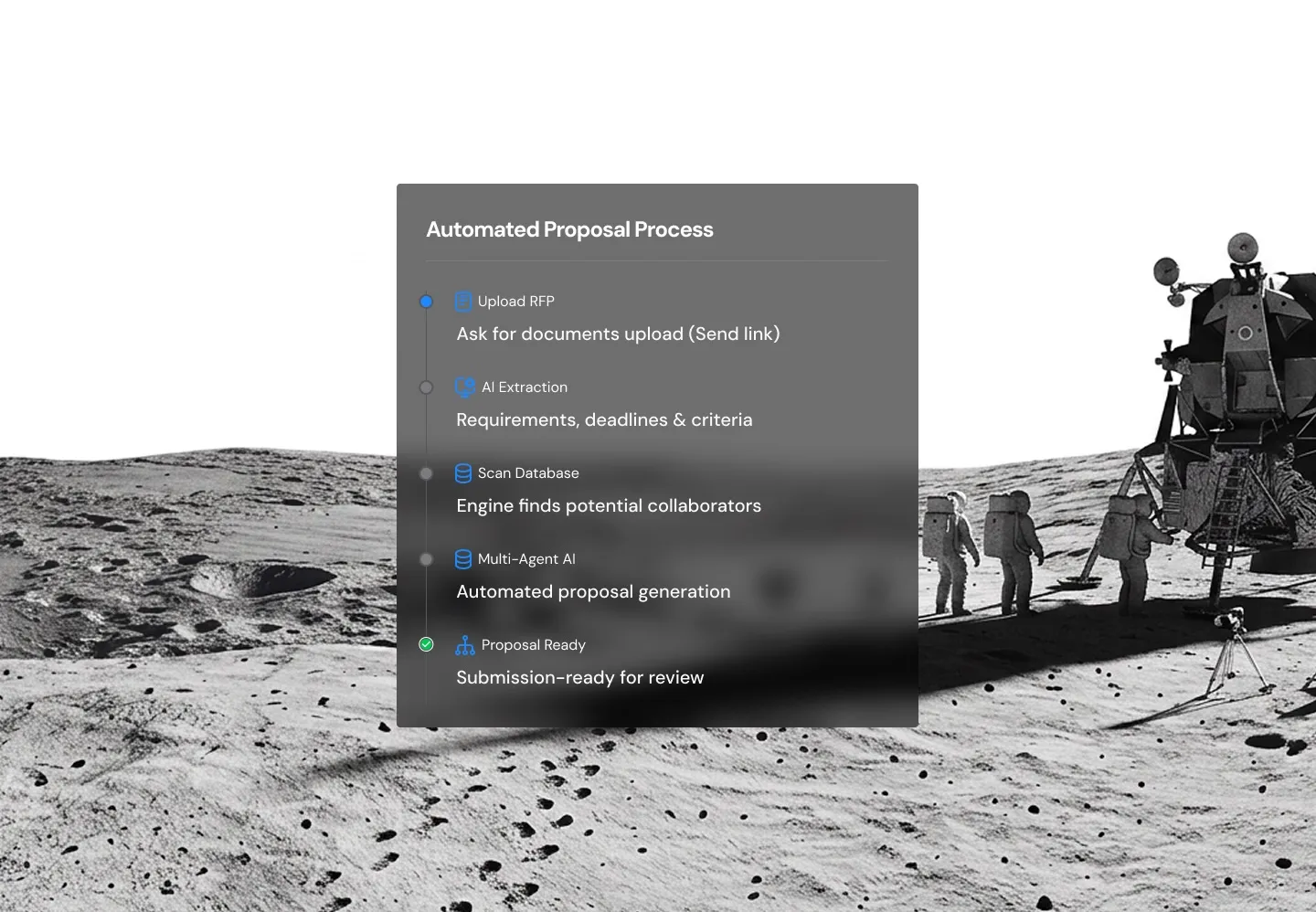
A structured, phase-by-phase coaching AI system with an opinion about what needs to happen at each stage of proposal development. The AI knows where the user is in the process and injects the right guidance; not generic prompts, but phase-specific coaching built around how institutional proposals are actually evaluated.
The organization’s own documents enrich the AI context throughout. Every response is specific to what that institution has actually built. Nothing is recycled across clients or sessions. IP protection wasn’t added after the fact; it was an architectural requirement from day one.
The architecture is the same for any organization that holds proprietary knowledge and needs AI to work from it; not around it.
How it works
The coaching architecture:
- 12-phase framework moves users from raw idea to submission-ready proposal.
- Phase-specific dynamic prompts injected at each stage; there is no single static prompt file.
- Prompts stored in a dedicated Supabase table, editable by the Career Haven team without developer involvement.
The knowledge layer:
- Users upload existing program materials, prior proposals, and internal research.
- Platform vectorizes them into a persistent organization-specific knowledge base in Supabase via OpenAI embeddings.
- Every AI response draws from what that organization has actually built; nothing pulled from generic training data.
IP protection, built from day one:
- Paid OpenAI API plan; user data is never used to train OpenAI’s models.
- Role-based access control isolates organizations from each other at the database query level, not just the UI layer.
- Data encrypted in transit across all integrations.
- Architecture designed to pass institutional procurement review before the first university client was onboarded.
The technical refactor (from n8n to custom Node.js/TypeScript backend):
- Each phase routes through a purpose-built backend; requests processed asynchronously, responses returned via webhooks.
- Full team visibility into what’s happening at every step, documented in GitHub per flow.
- 40% reduction in token usage by eliminating redundant steps from the old architecture.
- AI lag eliminated; the intermittent 20-minute response delays that were degrading user sessions are resolved.

Multi-model orchestration via OpenRouter:
- Gemini Flash for fast conversational responses and broad document understanding across proposal phases.
- Gemini visual models for reading PDFs containing images, tables, diagrams, and complex formatting.
- OpenAI embeddings for vectorizing uploaded documents into Supabase and powering organization-specific knowledge retrieval.

The Outcome
- 40% reduction in token usage after migrating to the custom Node.js/TypeScript backend.
- AI lag eliminated; intermittent 20-minute response delays resolved.
- Complex document handling fixed; PDFs with tables, images, diagrams, and numeric data now process reliably.
- Institutional procurement cleared; IP protection architecture passed university legal and procurement review; this was the prerequisite for operating in this market at all.
- Platform operating in institutional channels it was architecturally locked out of before; university legal and procurement clearance was the market entry, not just a compliance checkbox.
The goal is to show that we are drawing knowledge from experts all the time. It's not just what the AI is making up.
CHIIP is the grant writing use case. The architecture; organization-specific knowledge, IP protection by design, structured phase guidance; is the same system we build for any serious company whose competitive advantage lives in proprietary knowledge they can’t hand to a consumer AI platform.

What’s Next
CHIIP is positioned to guarantee that value is created regardless of whether a proposal wins funding. A completed proposal opens three paths: if the agency funds it, it becomes an active program. If it doesn’t win, the developed program becomes a consumer product. For university partners, it becomes a publication.
The platform doesn’t end at submission; it ends when the work creates lasting impact. If your organization is navigating a compliance-sensitive AI problem, that’s exactly where Phos AI Labs starts.