Objection forming
The prospect is starting to push back. The card surfaces the acknowledgment line that softens the next thirty seconds.
Phos Sales Assistant reads the call your rep is on. It hears what the prospect just said and surfaces the line your senior closer would use, before the next sentence lands.
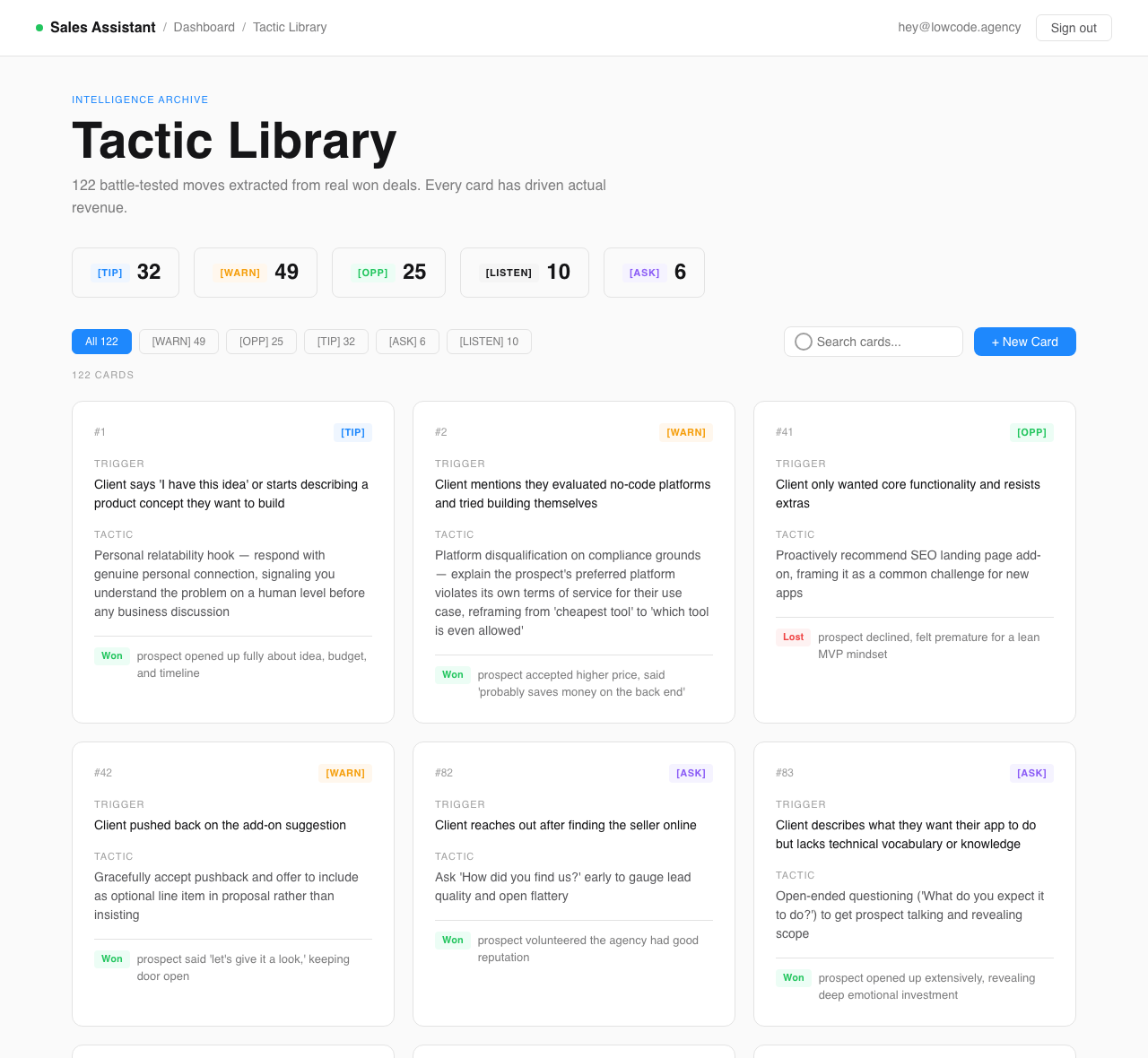
The Assistant is trained on your closed-won corpus and runs while the call is still live. The moves your top closers actually use, on every rep's screen.
Every sales rep has had this moment. The prospect says the thing. The brain scrambles. The line lands flat. Forty minutes later, in the car, the perfect response shows up. Useless.
Top closers have done this enough times that the pattern is already in their head. They hear the objection start to form and they neutralize it before the sentence finishes. They don't have better instincts; they have more reps.
That pattern is the leverage. We made it portable.
The Assistant runs as a transparent overlay outside the screen-share frame. The prospect sees the call. The rep sees the call and the next move. Audio in, tactic cards out. Sub-second response.
It is not a transcript tool. It is not a CRM scribe. It is the senior closer's playbook, present on every call; quiet most of the time, sharp when it matters.
| Generic AI for sales | Phos Sales Assistant | |
|---|---|---|
| Reads the call live | Summarizes after it ends | Yes, sub-second response |
| Trained on your won deals | Generic | Yes, your real transcripts |
| Surfaces tactics in the moment | Notes for later | Cards stream while the call is live |
| Visible to the prospect | Yes, lives in the call window | No, transparent overlay |
| Knows the signal types | Generic | Warn, Opp, Tip, Ask, Listen |
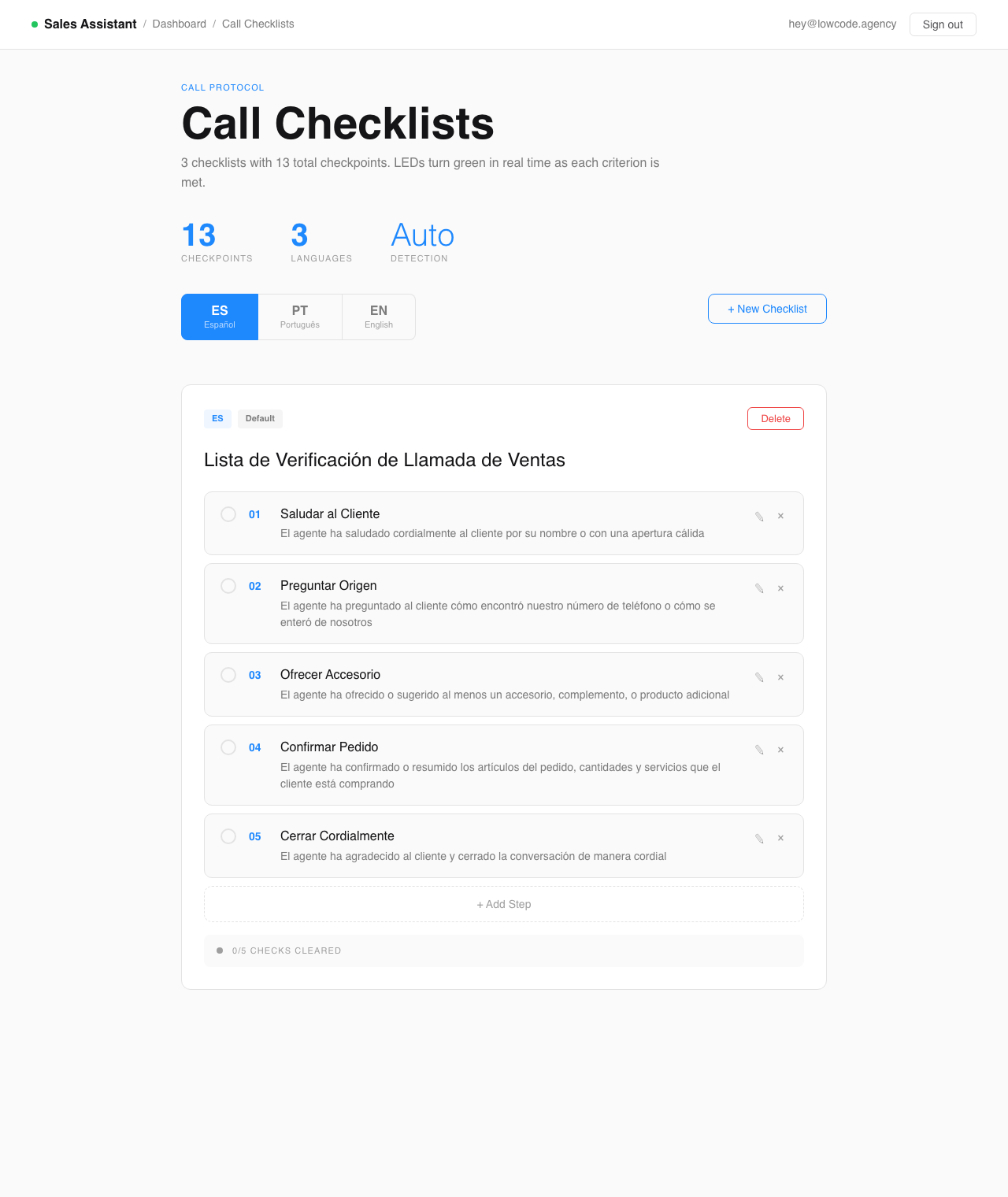
| Auto-tracks the qualification checklist | No | Live indicators per call |
The model classifies what the prospect just said and matches it to the right move. Each signal type fires its own card so the rep can read it at a glance.
The prospect is starting to push back. The card surfaces the acknowledgment line that softens the next thirty seconds.
An implementation question, a timeline question, a decision-maker name. The card cues the move toward next step.
Mirror the prospect's framing. Re-anchor the price. Use the proof point you already have for their industry.
When the conversation drifts away from a qualifying point, the card hands you the question that pulls it back.
The model detects rep over-talking, especially mid-objection. The card tells the rep to stop. The prospect needs space to finish the thought.
We map how your team sells today. Sales process, conferencing stack, the moves your top closers already use. The week-one alignment that decides what the library should learn.
We ingest your closed-won calls and generate the tactic library against your real wins. Objection patterns at your deal size. Proof points your buyer responds to. Reviewed with you before reps see anything.
Reps download the desktop app for Windows or macOS. The overlay auto-detects when a call starts and prompts the rep to begin the session. Cards stream while the prospect speaks.
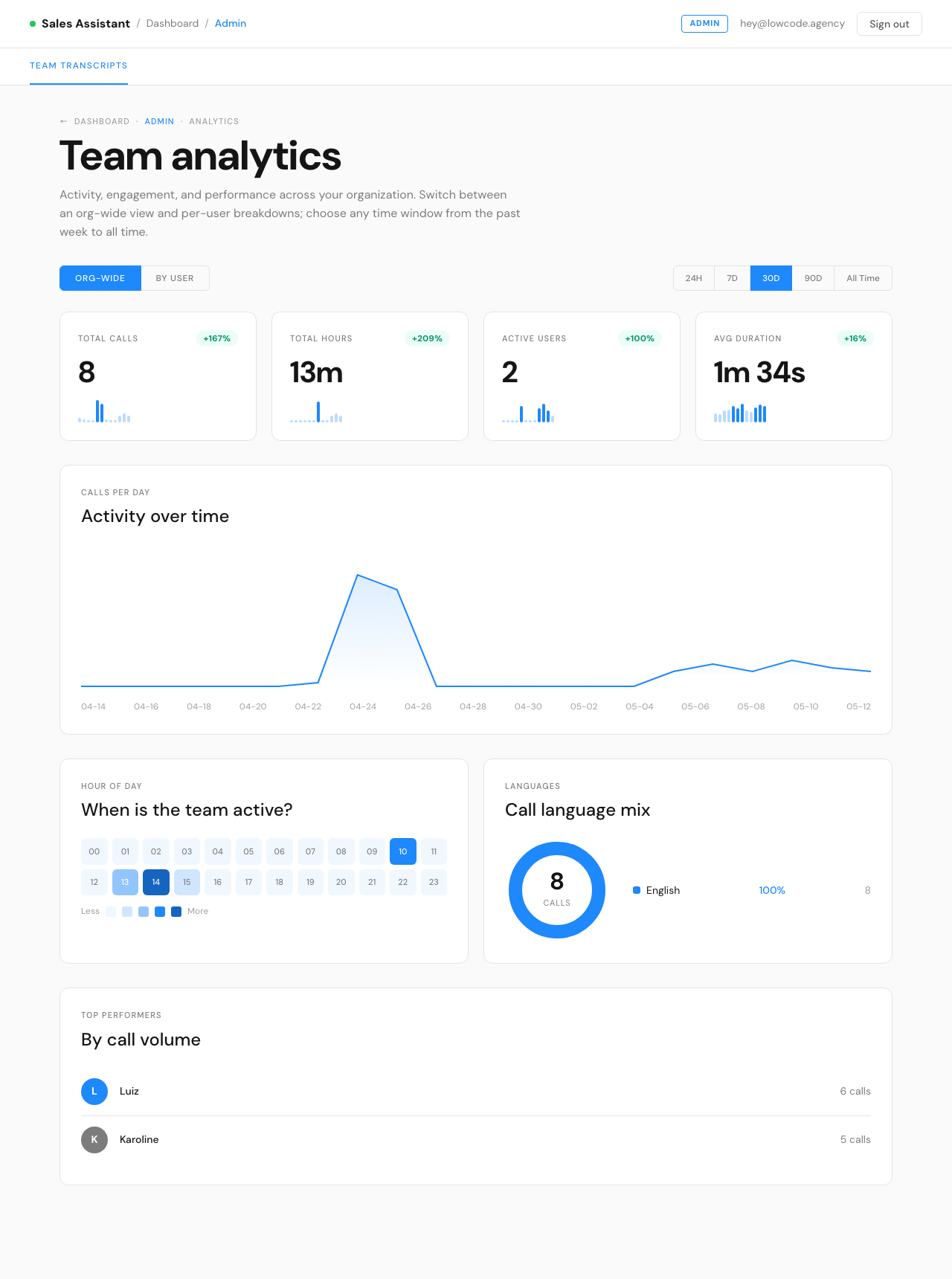
An admin dashboard surfaces team performance, conversion patterns, signal usage, and where reps need coaching. The data feeds back into the library so the cards keep sharpening.
$1,000/month
Up to twenty seats included.
Priced by company. We don't count seats or charge per rep.
What's included
Before we offered the Assistant to a single outside team, we built the tactic library inside our parent firm. Every closed-won call from the last two years went through it. The patterns that produced wins were extracted, card by card.
120 cards covering objection handling, pricing conversations, multi-stakeholder navigation, technical proof points, timing plays, and the small language tics that move a deal from soft yes to signed.
When you onboard, your library is calibrated against your own won-deal corpus. Generic patterns from our internal library are the starting point. Your won deals raise the bar. Your top closers' moves become your team's moves. That's the leverage.
Closed-won call
Pacific Crest · 32 minutes
Your library
120
The desktop app runs on macOS and Windows. Each rep needs a machine that meets these minimums.
| Requirement | Minimum |
|---|---|
| Operating system | macOS 13.2 (Ventura) |
| Processor | Apple Silicon or Intel |
| Memory | 6 GB RAM |
| Storage | 500 MB free |
| Internet | Stable broadband (5 Mbps+) |
| Permissions | Microphone + Screen Recording |
| Requirement | Minimum |
|---|---|
| Operating system | Windows 10 (64-bit) |
| Processor | Dual-core |
| Memory | 8 GB RAM |
| Storage | 500 MB free |
| Internet | Stable broadband (5 Mbps+) |
| Permissions | Microphone |