

Your intuition isn’t failing you. AI spending may once have been a single item in the monthly budget, but it has become a laundry list of wonders spanning enterprise investment, employee subscriptions to ChatGPT, Claude and all the usual suspects, API usage, infrastructure, inference, implementation and governance, plus the hidden cost of tools nobody uses anymore.
Do we still love AI? Heck yeah. It makes work easier, improves productivity and can compress six months of work into six days.
But a $20 seat for the hottest LLM is not comparable to a $60,000 Met Gala ticket. Nor is a data-center commitment comparable to a business unit’s AI budget. They belong to different categories, serve different purposes and need to be measured differently.
Businesses want to understand where their money is going.
Here at Phos AI Labs, we created this guide to separate the major categories of AI spending so leaders, journalists and researchers can compare like with like and see where the money is actually going, hopefully not to the Met Gala.
Key takeaways
AI spending is climbing fast. Enterprise-wide value is moving much more slowly.
- Worldwide AI spending is forecast to reach $2.528 trillion in 2026, up 44% year over year. (Gartner, January, 2026)
- 88% of organizations use AI in at least one business function, yet only about one-third are scaling it enterprise-wide. (McKinsey & Company, November, 2025)
- AI infrastructure alone is forecast at $1.366 trillion in 2026, more than half of total AI spending. (Gartner, January, 2026)
- Organizations expect to allocate 5% of annual business budgets to AI in 2026, up from 3% in 2025. (Capgemini Research Institute, January, 2026)
- AI services are forecast to reach $588.6 billion and AI software $452.5 billion in 2026. (Gartner, January, 2026)
- 39% of organizations report any enterprise-level EBIT impact from AI; most of that group attributes less than 5% of EBIT to it. (McKinsey & Company, November, 2025)
- 86% of surveyed leaders expect AI infrastructure budgets to increase over three years; the average expected budget more than triples. (Deloitte, April, 2026)
- ChatGPT consumer plans range from $8 Go and $20 Plus to $100 or $200 Pro tiers. (OpenAI, January, 2026) (OpenAI, August, 2026)
- Alphabet expects $175–$185 billion of 2026 capital expenditure and says it reduced Gemini serving unit costs 78% during 2025. (Alphabet, February, 2026)
- The clearest buying lesson is not “spend more.” It is to consolidate seats, measure workflow-level outcomes and move variable workloads to the cheapest model that still meets the quality bar. (McKinsey & Company, November, 2025)
Global AI spending statistics
The market is not short of money. The harder question is where it lands: infrastructure first, then services, software, security and the operating work required to make any of it useful.
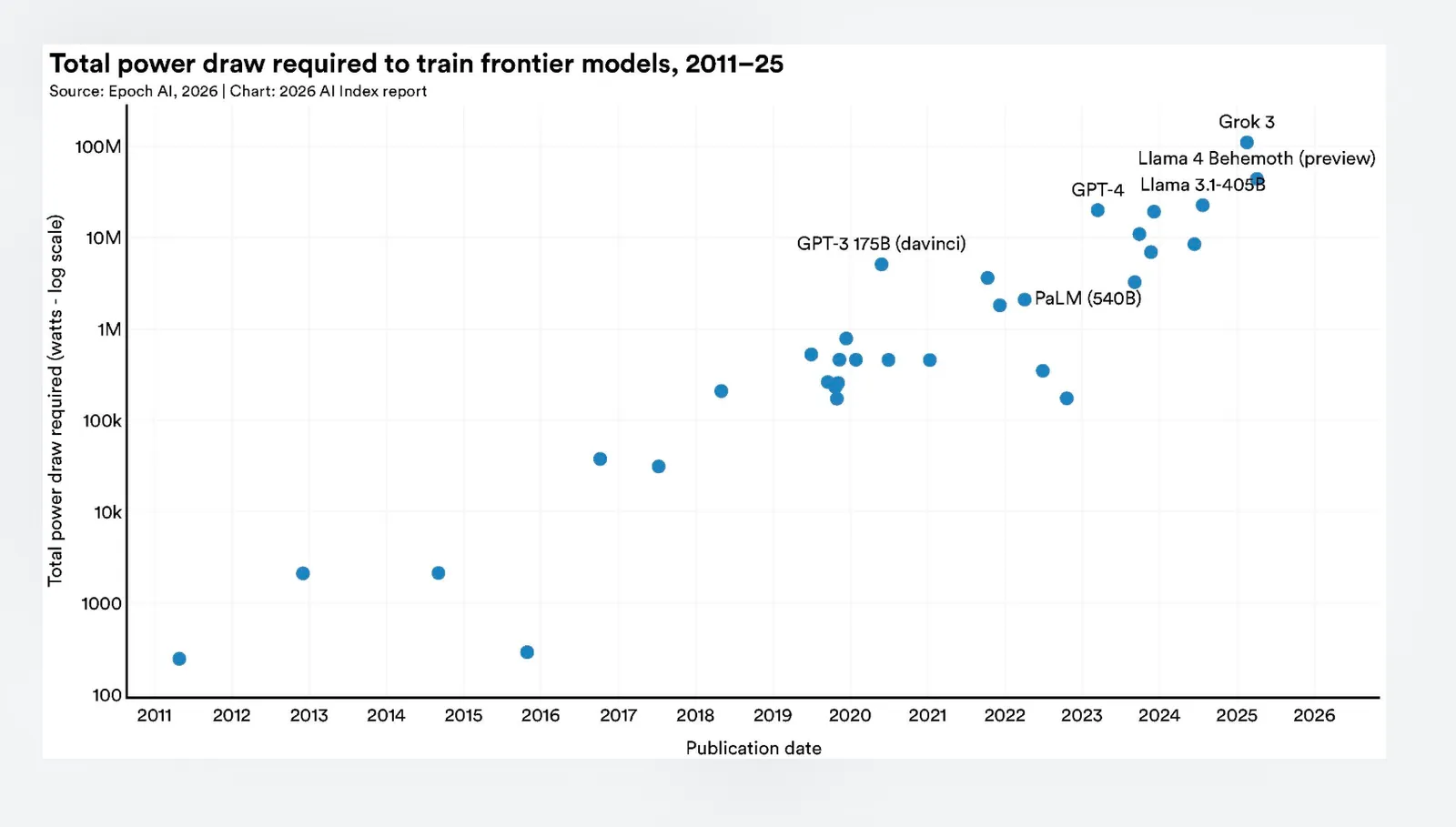
Source: Inside the AI Index: 12 Takeaways from the 2026 Report
Worldwide AI investment
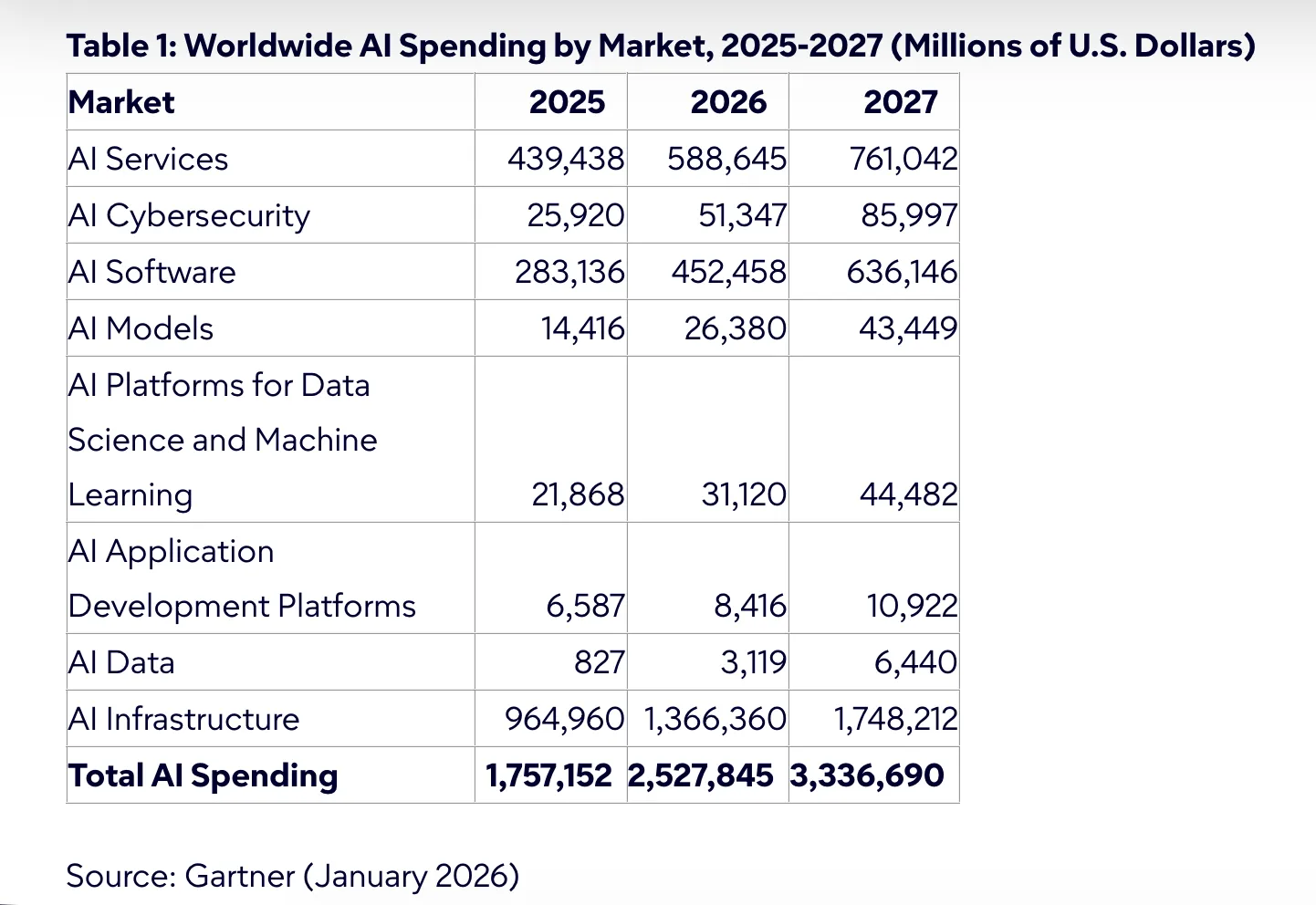
- Total worldwide AI spending rises from $1.757 trillion in 2025 to $2.528 trillion in 2026 and is forecast to reach $3.337 trillion in 2027. (Gartner, January, 2026)
- IDC separately projects worldwide AI spending to exceed $630 billion by 2028, with generative AI representing 17.2% of that total, a narrower scope than Gartner’s device-and-infrastructure-inclusive forecast. (IDC, May, 2026)
- Stanford’s 2026 AI Index estimates global corporate AI investment reached $581.7 billion in 2025, up 130% from 2024; private AI investment reached $344.7 billion, up 127.5%. (Stanford HAI, April, 2026)
- AI firms attracted $258.7 billion in global venture capital in 2025, 61% of all VC investment, double AI’s 30% share in 2022. (OECD, February, 2026)
- AI accounted for 53% of global venture-capital deal value by Q3 2025, up from 32% in Q3 2024; Northern America absorbed about $162 billion in AI-related VC. (WIPO, November, 2025)
- UN Trade and Development projects the global AI market will grow from $189 billion in 2023 to $4.8 trillion in 2033, a 25-fold increase. (UNCTAD, April, 2025)
- The 2026 forecast implies roughly $770.7 billion of additional AI spending in a single year. (Gartner, January, 2026)
- AI infrastructure rises from $965.0 billion in 2025 to $1.366 trillion in 2026 and $1.748 trillion in 2027. (Gartner, January, 2026)
- AI services rise from $439.4 billion in 2025 to $588.6 billion in 2026. (Gartner, January, 2026)
- AI software rises from $283.1 billion in 2025 to $452.5 billion in 2026. (Gartner, January, 2026)
- AI model spending rises from $14.4 billion in 2025 to $26.4 billion in 2026, an 83% increase. (Gartner, January, 2026)
- AI cybersecurity spending nearly doubles, from $25.9 billion in 2025 to $51.3 billion in 2026. (Gartner, January, 2026)
Enterprise AI budgets
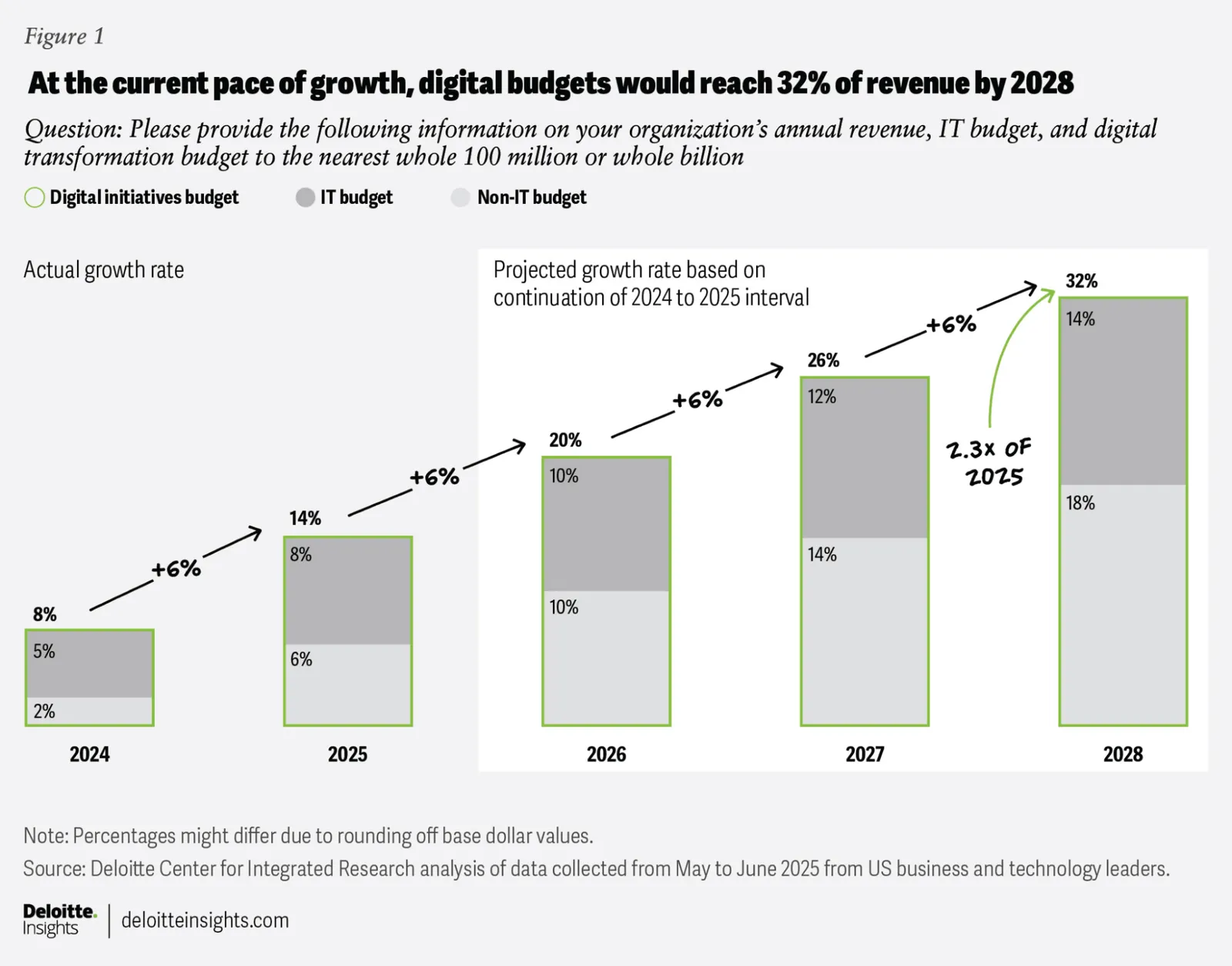
Source: AI and tech investment ROI | Deloitte Insights
- Functional leaders reported allocating an average 12% of their 2025 budgets to AI, and 85% planned to increase AI spending in 2026. Gartner surveyed 1,303 respondents between January and April 2026 at organizations with at least $50 million in fiscal 2025 revenue. (Gartner, September, 2026)
- 74% of organizations in Deloitte’s 2025 Tech Value Survey invested in AI or generative AI, 19 points above data management and architecture at 55%. (Deloitte, November, 2025)
- Capgemini’s 2026 research says organizations expect AI to absorb 5% of annual business budgets, versus 3% in 2025. (Capgemini Research Institute, January, 2026)
- 78% of Deloitte respondents planned to increase overall AI spending in the next fiscal year. (Deloitte, January, 2025)
- Deloitte’s survey found an average digital budget of $1.8 billion against $13.4 billion in average revenue, equal to 13.7% of revenue in 2025. (Deloitte, November, 2025)
AI spending by company size
- Nearly half of the companies above $5 billion in revenue were scaling AI, compared with 29% of companies below $100 million. (McKinsey & Company, November, 2025)
- Companies with at least $500 million in revenue deploy generative AI across more functions and redesign workflows faster than smaller organizations. (McKinsey & Company, March, 2025)
- Large enterprises expect AI infrastructure budgets to grow almost fourfold over three years, versus more than threefold for the full sample. (Deloitte, April, 2026)
AI spending by region
- The United States accounted for $69.2 billion, or 77%, of worldwide AI infrastructure spending in Q4 2025; spending grew 81% year over year. (IDC, May, 2026)
- Asia-Pacific excluding Japan grew AI infrastructure spending 47% year over year in Q4 2025, while Western Europe grew 42%. (IDC, May, 2026)
- China accounted for $8.4 billion, or 9.4%, of worldwide AI infrastructure spending in Q4 2025. (IDC, May, 2026)
- 20% of EU enterprises used AI in 2025, including 55% of large businesses versus 19% of SMEs. (Eurostat, July, 2026)
AI spending per employee
Per-employee cost looks simple until access and usage split apart. The cleanest benchmark combines paid seats, active users, shared API consumption and the cost of enabling the team.
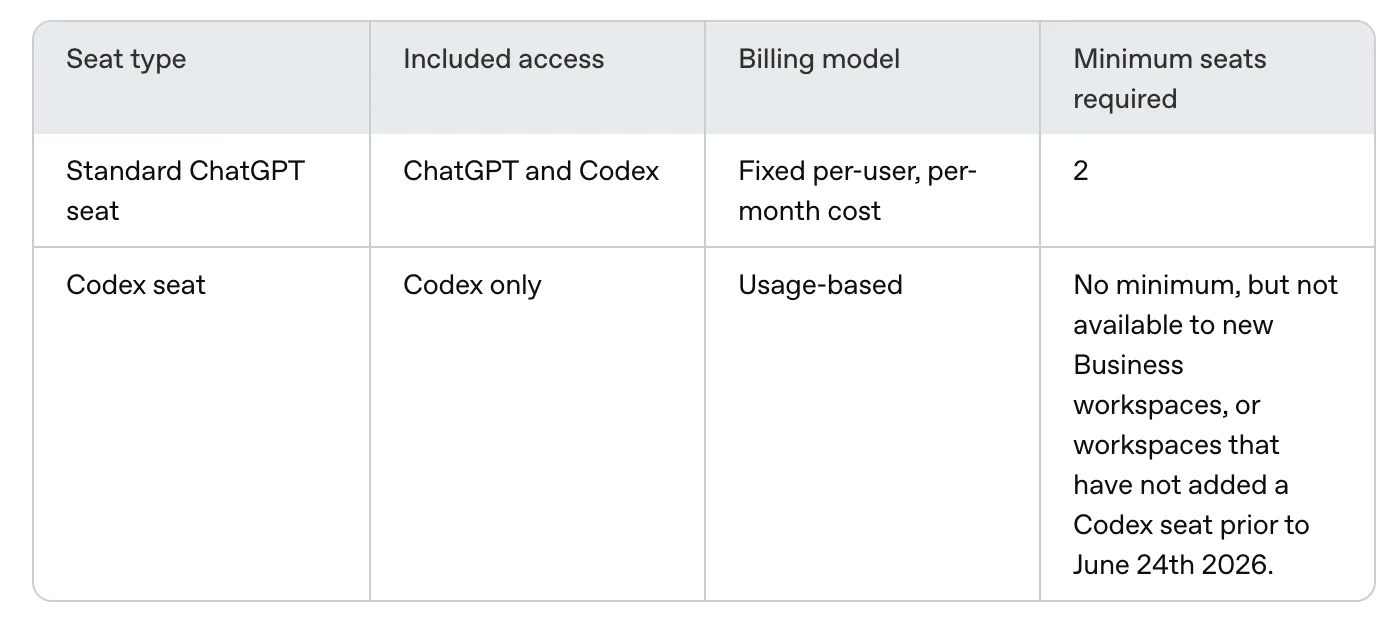
Source: What is ChatGPT Business? | OpenAI Help Center
AI budget per employee
There is no defensible universal “average AI spend per employee.” Company-wide capital investment, centrally funded APIs and optional subscriptions create different denominators. The useful benchmark is a range built from the actual deployment model.
- Across Ramp’s transaction data, the median AI adopter spent $11.95 per employee per month, while the top 10% spent $650 and the top 1% spent more than $7,400. The report covers anonymized transactions from more than 70,000 businesses and describes observed Ramp customers rather than a universal employer benchmark. (Ramp, September, 2026)
- Perplexity Enterprise Pro costs $40 per active seat monthly or $400 annually, making the annual plan 16.7% cheaper than paying monthly for 12 months. (Perplexity, July, 2026)
- Public list prices annualize to $240 for a $20 monthly seat, $300 for $25 and $360 for $30. (OpenAI, August, 2026) (Anthropic, August, 2026)
- Perplexity Enterprise Max costs $325 per active seat monthly or $3,250 annually. (Perplexity, July, 2026)
- A 500-person ChatGPT Business rollout at the $20 annual-plan rate costs $120,000 a year before credits, training, integration and governance. (OpenAI, August, 2026)
- A 1,000-person rollout at $30 per seat costs $360,000 annually; 70% active use would raise effective cost per active user from $360 to about $514. (Microsoft, July, 2026)
AI adoption by employee count
- 82% of leaders said 2025 was pivotal for rethinking strategy and operations, while 80% of workers lacked enough time or energy to do their jobs. (Microsoft, April, 2025)
- Deloitte found generative AI access remained below 40% of the workforce at surveyed organizations. (Deloitte, January, 2025)
- 88% of organizations use AI somewhere, but only one-third scale programs across the enterprise, evidence that access is not the same as adoption. (McKinsey & Company, November, 2025)
- More than two-thirds of Deloitte respondents expected 30% or fewer of current experiments to scale fully within three to six months. (Deloitte, January, 2025)
- 62% of organizations are at least experimenting with AI agents. (McKinsey & Company, November, 2025)
AI subscription costs
Subscriptions are the most visible line item, and the easiest place for sprawl to hide. The prices below are public list prices, not negotiated enterprise quotes.
Seat prices are the visible part of AI software cost. The operating cost is seats multiplied by adoption, plus premium usage, storage, connectors, administration, security and change management.
ChatGPT pricing statistics
- ChatGPT Free costs $0, Go costs $8 per month in the US and Plus costs $20 per month. (OpenAI, January, 2026)
- ChatGPT Pro now has $100 and $200 monthly tiers, offering 5x and 20x the usage allowance of Plus respectively. (OpenAI, August, 2026)
- ChatGPT Business costs $25 per user monthly or $20 per user monthly on annual billing, and standard ChatGPT access requires at least two seats. (OpenAI, August, 2026)
- At list price, 1,000 ChatGPT Business seats cost $240,000 a year on annual billing or $300,000 across 12 monthly payments, a $60,000 difference. (OpenAI, August, 2026)
- ChatGPT Enterprise remains quote-based, and ChatGPT subscriptions do not include API usage; API consumption is billed separately. (OpenAI, August, 2026)
- Industry spending benchmark: General-purpose AI copilots, including ChatGPT Enterprise, Claude for Work and Microsoft Copilot, captured an estimated $7.2 billion of enterprise spending in 2025, or 86% of the $8.4 billion horizontal-AI market. (Menlo Ventures, December, 2025)
Claude pricing statistics
- Claude Free costs $0, Pro costs $20 per month, Max 5x costs $100 and Max 20x costs $200. (Anthropic, August, 2026)
- Claude Team costs $25 per member monthly on annual billing or $30 monthly, with a five-member minimum. (Anthropic, August, 2026)
- Claude Enterprise is quote-based and adds organization-wide administration, security and governance controls. (Anthropic, August, 2026)
- Industry spending benchmark: Anthropic captured an estimated 40% of the $12.5 billion enterprise LLM API market in 2025, about $5.0 billion, up from 24% in 2024. This measures production API spending rather than Claude seat subscriptions. (Menlo Ventures, December, 2025)
Gemini pricing statistics
- Google Workspace Starter costs $7 per user monthly on annual billing, Standard costs $14 and Plus costs $22; Gemini is included at different access levels. (Google, August, 2026)
- Google Workspace Enterprise is quote-based, while Starter, Standard and Plus are capped at 300 users. (Google, August, 2026)
- Alphabet reported more than 8 million paid Gemini Enterprise seats four months after launch. (Alphabet, February, 2026)
- Industry spending benchmark: Google captured an estimated 21% of the $12.5 billion enterprise LLM API market in 2025, about $2.6 billion, up from 7% in 2023. This measures production API spending rather than Gemini seat subscriptions. (Menlo Ventures, December, 2025)
Microsoft Copilot pricing statistics
- Microsoft 365 Copilot Chat is available at no additional charge with eligible Microsoft 365 subscriptions. (Microsoft, July, 2026)
- Microsoft’s 2026 partner materials list Microsoft 365 Copilot at $30 per user monthly on annual billing and Copilot Business at $21. (Microsoft, July, 2026)
- Monthly billing can carry a premium: Copilot Business was listed at $25.20 per month versus $21 on annual billing. (Microsoft, July, 2026)
- Microsoft’s 2026 partner billing guide caps Copilot Business at 300 seats, while Microsoft 365 Copilot supports deals from 1 to 9,999 seats. (Microsoft, April, 2026)
- Industry spending benchmark: ChatGPT Enterprise, Claude for Work and Microsoft Copilot collectively led a $7.2 billion enterprise-copilot market in 2025, representing 86% of horizontal AI application spending. (Menlo Ventures, December, 2025)
Perplexity pricing statistics
- Enterprise Pro costs $40 per active seat monthly or $400 annually; larger teams of 250+ may qualify for discounts. (Perplexity, July, 2026)
- Enterprise Max costs $325 per seat monthly or $3,250 annually. (Perplexity, July, 2026)
- Annual Enterprise pricing is two months cheaper than paying monthly for a year. (Perplexity, July, 2026)
- Perplexity’s plan guide confirms Enterprise Pro starts at $40 monthly or $400 annually per seat and includes centralized billing and organization-wide knowledge search. (Perplexity, July, 2026)
- Industry spending benchmark: Public research does not isolate average company spending on Perplexity; the closest comparable category, general-purpose enterprise copilots, captured an estimated $7.2 billion in 2025. (Menlo Ventures, December, 2025)
GitHub Copilot pricing statistics
- GitHub Copilot Free includes 2,000 completions per month. (GitHub, August, 2026)
- Copilot Pro costs $10 per user monthly and includes $15 in monthly AI credits. (GitHub, August, 2026)
- Copilot Pro+ costs $39 monthly and includes $70 in AI credits; Copilot Max costs $100 and includes $200. (GitHub, August, 2026)
- One GitHub AI credit equals $0.01, and paid overages can be governed with budgets and alerts at 75%, 90% and 100%. (GitHub, August, 2026)
- GitHub’s billing documentation lists Copilot Business at $19 per user monthly and notes that coding-agent work can consume both Actions minutes and premium requests. (GitHub, August, 2026)
- Industry spending benchmark: Enterprise spending on AI coding tools reached $4.0 billion in 2025, up from $550 million in 2024; code-completion products alone captured $2.3 billion. (Menlo Ventures, December, 2025)
Other major AI subscriptions
- Cursor Pro costs $20 per month and includes $20 of API agent usage; Teams Standard costs $40 monthly or $32 on annual billing, while Teams Premium costs $120 monthly or $96 annually. (Cursor, June, 2026)
- Industry spending benchmark: Cursor reached $200 million in revenue before hiring its first enterprise sales representative, within an AI coding market that reached $4.0 billion in 2025. (Menlo Ventures, December, 2025)
- Midjourney costs $10, $30, $60 or $120 monthly across Basic, Standard, Pro and Mega; annual billing is 20% cheaper. (Midjourney, August, 2026)
- Industry spending benchmark: Creator-focused generative AI tools, the category that includes image platforms such as Midjourney, captured an estimated $360 million in enterprise spending in 2025. (Menlo Ventures, December, 2025)
- Runway costs $15, $35 or $95 monthly for Standard, Pro and Max; annual billing reduces those effective rates to $12, $28 and $76. (Runway, August, 2026)
- Industry spending benchmark: Creator-focused generative AI tools, the category that includes video platforms such as Runway, captured an estimated $360 million in enterprise spending in 2025. (Menlo Ventures, December, 2025)
- ElevenLabs cut text-to-speech costs by up to 55%, speech-to-text by up to 45% and agent calls by up to 20% in May 2026; Starter agents fell to $0.08 per minute. (ElevenLabs, May, 2026)
- Industry spending benchmark: Creator-focused generative AI tools, the category that includes voice platforms such as ElevenLabs, captured an estimated $360 million in enterprise spending in 2025. (Menlo Ventures, December, 2025)
- Notion Custom Agents cost $10 per 1,000 shared workspace credits; example runs range from about $0.03 to $0.30 depending on the workflow. (Notion, August, 2026)
- Industry spending benchmark: Personal-productivity AI tools captured an estimated $450 million in enterprise spending in 2025, while broader agent platforms captured $750 million. (Menlo Ventures, December, 2025)
AI API costs
API economics reward discipline. Model choice matters, but caching, batch processing, prompt length, output length and retry rates often matter more.
OpenAI API pricing
- GPT-5.6 Sol costs $5 per million input tokens, $0.50 cached input and $30 output. (OpenAI, August, 2026)
- GPT-5.6 Terra costs $2.50 per million input tokens, $0.25 cached input and $15 output. (OpenAI, August, 2026)
- GPT-5.6 Luna costs $1 per million input tokens, $0.10 cached input and $6 output. (OpenAI, August, 2026)
- For GPT-5.6 Sol, prompts above 272,000 input tokens are billed at 2x input and 1.5x output for the full request; cache writes cost 1.25x uncached input. (OpenAI, August, 2026)
Anthropic API pricing
- Anthropic’s May 2026 Opus list price was $5 per million input tokens and $25 per million output tokens globally. (Anthropic, May, 2026)
- Batch Opus pricing was $2.50 per million input tokens and $12.50 per million output tokens, a 50% discount. (Anthropic, May, 2026)
- Five-minute cache writes were $6.25 per million tokens, one-hour writes $10 and cache hits $0.50. (Anthropic, May, 2026)
- US-only inference carried a 10% premium in the published Opus rate card. (Anthropic, May, 2026)
- Anthropic’s API documentation prices cache hits at 10% of standard input cost and gives the Batch API a 50% discount on both input and output tokens. (Anthropic, August, 2026)
Gemini API pricing
- Gemini 2.5 Pro standard pricing is $1.25 per million input tokens and $10 output for prompts up to 200,000 tokens. (Google, July, 2026)
- Above 200,000 tokens, Gemini 2.5 Pro rises to $2.50 input and $15 output per million tokens. (Google, July, 2026)
- Gemini 2.5 Pro batch pricing halves input and output rates to $0.625 and $5 for prompts up to 200,000 tokens. (Google, July, 2026)
- Gemini 2.5 Flash Image lists $0.039 per generated image on standard processing and $0.0195 on batch. (Google, July, 2026)
- Google Cloud lists Gemini batch mode at a 50% discount and provisioned throughput at $2,000 to $2,700 per GSU monthly, depending on commitment length. (Google Cloud, August, 2026)
xAI API pricing
- Grok 4.5 costs $2 per million input tokens, $0.30 cached input and $6 output; requests above 200,000 context tokens double those rates. (xAI, July, 2026)
- xAI’s Grok 4.5 model page repeats the $2 input and $6 output rates and recommends prompt cache keys to avoid paying full input price on cache-cold requests. (xAI, July, 2026)
Mistral API pricing
- Mistral Medium 3.5 costs $1.50 per million input tokens and $7.50 output, while Mistral Small 4 costs $0.15 input and $0.60 output; batch processing is 50% cheaper. (Mistral AI, August, 2026)
- Mistral’s Batch API processes high-volume asynchronous requests at 50% lower cost than synchronous API calls. (Mistral AI, November, 2024)
DeepSeek API pricing
- DeepSeek V4 Flash costs $0.0028 per million cache-hit input tokens, $0.14 for cache misses and $0.28 output; V4 Pro costs $0.003625, $0.435 and $0.87. (DeepSeek, August, 2026)
- DeepSeek’s caching launch reported cost reductions of up to 90% for repeated inputs and average historical savings above 50%, with no separate cache-storage fee. (DeepSeek, August, 2024)
Open-source inference costs
- Open-weight models remove a per-seat license but do not remove GPU, orchestration, monitoring, security, evaluation or staff costs. (IBM Institute for Business Value, October, 2024)
- Self-hosting becomes economical only when utilization is high enough to offset idle capacity and the team can operate the stack reliably. (IBM Institute for Business Value, October, 2024)
- Mistral said Medium 3 could be self-deployed on four GPUs or more, illustrating the hardware floor that remains after per-seat licensing disappears. (Mistral AI, May, 2025)
AI costs by use case
A token is not a business outcome. Coding, voice, video, support and research each have different cost units, failure modes and review requirements.
Coding AI
- GitHub’s controlled experiment found developers completed a coding task 55% faster with Copilot. (GitHub, September, 2022)
- A $10–$100 monthly coding subscription can be cheaper than a single developer hour, but review, testing and security remain in the workflow. (GitHub, August, 2026)
- Industry spending benchmark: Organizations spent an estimated $4.0 billion on AI coding tools in 2025, up more than sevenfold from $550 million in 2024 and equal to 55% of departmental AI spending. (Menlo Ventures, December, 2025)
Writing AI
- 63% of organizations using generative AI produce text outputs, the most common modality in McKinsey’s survey. (McKinsey & Company, March, 2025)
- Anthropic found 81% of Claude conversations producing blogs or articles were work-related, as were 80% of conversations producing marketing content. (Anthropic, June, 2026)
- Writing cost is driven less by first-draft tokens than by fact-checking, brand review and the proportion of output that survives editing. (McKinsey & Company, March, 2025)
- Industry spending benchmark: AI marketing platforms, including content-generation and campaign-optimization tools, captured an estimated $660 million in enterprise spending in 2025. (Menlo Ventures, December, 2025)
Image generation
- More than one-third of organizations using generative AI generate images. (McKinsey & Company, March, 2025)
- Gemini 2.5 Flash Image lists standard output at $0.039 per image, before retries, upscaling and human selection. (Google, July, 2026)
- Industry spending benchmark: Creator-focused generative AI tools, which combine image, video and voice products, captured an estimated $360 million in enterprise spending in 2025; public research does not yet separate image-only spending. (Menlo Ventures, December, 2025)
Video generation
- Google listed Veo 2 at $0.35 per generated second before its June 2026 deprecation, illustrating why version dates matter in video cost comparisons. (Google, July, 2026)
- Runway’s published subscription range spans $15 to $95 monthly, or effective annual-billing rates of $12 to $76, before usage overages. (Runway, August, 2026)
- At $0.35 per generated second, a 60-second raw generation costs $21 before failed takes, extensions, editing or audio. (Google, July, 2026)
- Industry spending benchmark: Creator-focused generative AI tools captured an estimated $360 million in enterprise spending in 2025; public research does not yet separate video-only spending. (Menlo Ventures, December, 2025)
Voice generation
- Gemini 3.1 Flash Live Preview lists audio input at $0.005 per minute and audio output at $0.018 per minute. (Google, July, 2026)
- Voice-agent budgets must also include telephony, transcription, silence, interruption handling, testing and escalation to humans. (ElevenLabs, August, 2026)
- Industry spending benchmark: Creator-focused generative AI tools captured an estimated $360 million in enterprise spending in 2025; public research does not yet separate voice-only spending. (Menlo Ventures, December, 2025)
Customer support AI
- McKinsey found 63% of service-operations users reported cost reductions from generative AI, with 45% reporting revenue increases in the surveyed function. (McKinsey & Company, March, 2025)
- 70% of service organizations using AI agents reported measurable value within 60 days, while adoption rose from 39% in 2025 to 66% in 2026. (Salesforce, May, 2026)
- Industry spending benchmark: Customer-success AI tools captured an estimated $630 million in enterprise spending in 2025, including ticket routing, sentiment analysis and proactive outreach. (Menlo Ventures, December, 2025)
AI agents
- 62% of organizations are experimenting with agents, but nearly two-thirds of organizations have not started enterprise-wide AI scaling. (McKinsey & Company, November, 2025)
- Agent cost compounds across planning, tool calls, retrieved context, retries and verification; a “single task” may contain many model calls. (Google, July, 2026)
- Industry spending benchmark: Enterprise agent platforms captured an estimated $750 million in 2025, equal to 10% of horizontal AI application spending. (Menlo Ventures, December, 2025)
Search and research
- Gemini 3 pricing includes 5,000 grounded prompts monthly before $14 per 1,000 search queries for certain models. (Google, July, 2026)
- Perplexity Enterprise Pro starts at $40 per active seat monthly, while Enterprise Max raises Research and Create limits at $325 per seat monthly. (Perplexity, July, 2026)
- Gemini 2.5 Pro includes 1,500 grounded prompts daily before $35 per 1,000 grounded prompts. (Google, July, 2026)
- Industry spending benchmark: Public research does not isolate search-and-research spending; the closest comparable market, general-purpose enterprise copilots, captured an estimated $7.2 billion in 2025. (Menlo Ventures, December, 2025)
AI infrastructure spending
This is where the scale becomes hard to ignore. Servers, chips, data centers, power and cloud capacity now account for the majority of global AI spending.
GPU spending
- Gartner forecasts AI-optimized server spending will rise 49% in 2026 and represent 17% of total AI spending. (Gartner, January, 2026)
- NVIDIA reported $62.3 billion of Q4 fiscal 2026 data-center revenue, up 75% year over year; full-year data-center revenue reached $193.7 billion. (NVIDIA, February, 2026)
Data center investment
- Alphabet expects $175–$185 billion in 2026 capital expenditure, up from $91.4 billion in 2025. (Alphabet, February, 2026)
- Meta guided to $115–$135 billion of 2026 capex, Microsoft to roughly $190 billion and Amazon to about $200 billion; all three totals include assets beyond AI alone. (Meta, January, 2026) (Microsoft, April, 2026) (Amazon, February, 2026)
- About 60% of Alphabet’s 2025 capex went to servers and 40% to data centers and networking; management expects a similar 2026 mix. (Alphabet, February, 2026)
Cloud AI spending
- Google Cloud revenue grew 48% and backlog reached $240 billion; nearly 75% of Cloud customers had used its vertically optimized AI. (Alphabet, February, 2026)
- AWS sales reached $35.6 billion in Q4 2025, up 24% year over year, while full-year AWS sales rose 20% to $128.7 billion. (Amazon, February, 2026)
- AI customers used 1.8 times as many Google Cloud products as non-AI customers. (Alphabet, February, 2026)
- Google Cloud signed more deals above $1 billion in 2025 than in the previous three years combined. (Alphabet, February, 2026)
AI inference costs
- Atlassian’s internal benchmark found that agents using Teamwork Graph context delivered 44% better answer quality while using 48% fewer tokens than agents without that context. This is an Atlassian internal comparison, not an industry-wide inference-cost benchmark. (Atlassian, September, 2026)
- Alphabet reduced Gemini serving unit cost 78% during 2025 through model, efficiency and utilization improvements. (Alphabet, February, 2026)
- Batch APIs commonly cut list inference rates 50%, trading latency for lower unit cost. (Google, July, 2026)
AI chip market
- AI infrastructure adds an estimated $401 billion of spending in 2026 as technology providers build foundations. (Gartner, January, 2026)
- Just over half of Alphabet’s 2026 machine-learning compute is expected to support Google Cloud, with the remainder serving internal products and model development. (Alphabet, February, 2026)
Hidden costs of AI
The invoice rarely shows the whole bill. Empty seats, overlapping tools, weak adoption, integration work and human QA can cost more than the model itself.
Unused AI licenses
- If only 70% of paid seats are active, effective cost per active user is 43% higher than list price. (Microsoft, July, 2026)
- Deloitte found workforce access below 40%, while scaling remained limited, two signals that purchased availability can outrun embedded use. (Deloitte, January, 2025)
Shadow AI spending
- 80% of workers reported insufficient time or energy, creating pressure to adopt unsanctioned tools when approved systems do not fit the work. (Microsoft, April, 2025)
- Shadow AI creates duplicated subscriptions, untracked data exposure and no shared measurement, not just an extra $20 charge. (NIST, January, 2023)
Duplicate subscriptions
- A worker holding three $20–$30 AI seats creates $720–$1,080 of visible annual subscription cost before any API use. (OpenAI, April, 2026)
- For 500 employees, eliminating one redundant $20 seat saves $120,000 annually. (OpenAI, April, 2026)
- At Microsoft’s $21 annual-billing rate, 500 redundant Copilot Business seats cost $126,000 a year; at $25.20 monthly billing, the annualized cost is $151,200. (Microsoft, April, 2026)
AI tool overlap
- Multi-model access is now bundled into coding and research products, so buyers may pay twice for models already available through another seat. (GitHub, August, 2026)
- Amazon Bedrock offered more than 20 managed models and let customers test or switch between them without rewriting code, increasing the overlap hidden inside a single platform. (Amazon, February, 2026)
Training costs
- Surveyed U.S. desk workers spent an estimated 20 workdays per year troubleshooting AI errors and iterating on prompts, while the study reported that 63% of organizations had raised AI-tool budgets. BambooHR surveyed 1,608 full-time salaried workers, including 520 HR professionals, from June 26 to July 15, 2026. (BambooHR, September, 2026)
- Only one-third of organizations scale AI enterprise-wide, and larger organizations progress faster, evidence that rollout work, not model access alone, determines adoption. (McKinsey & Company, November, 2025)
- Leaders expect employees to be training 41% of agents and managing 36% of them within five years, turning agent supervision into a material workforce-development requirement. (Microsoft, April, 2025)
Security and compliance costs
- Regulatory-compliance concern rose from 28% to 38% across Deloitte’s 2024 survey waves. (Deloitte, January, 2025)
- 74% of respondents identified inaccuracy and 72% cited cybersecurity as highly relevant AI risks; nearly two-thirds named security and risk concerns as the top barrier to scaling agents. (McKinsey & Company, April, 2026)
- 69% of respondents believed full AI governance implementation would take at least one year. (Deloitte, January, 2025)
Integration costs
- AI becomes valuable when embedded into processes, but connectors, identity, permissions, data cleaning and monitoring create implementation cost beyond model fees. (McKinsey & Company, March, 2025)
- 83% of service decision-makers planned to increase data-integration investment, showing that the data layer often becomes part of the AI implementation bill. (Salesforce, April, 2024)
Hallucination and QA costs
- NIST’s AI Risk Management Framework treats validity, reliability, safety, security, transparency and accountability as operational requirements, not optional polish. (NIST, January, 2023)
- Nearly one-quarter of respondents said their organizations had experienced negative consequences from generative AI inaccuracy, directly increasing evaluation and review requirements. (McKinsey & Company, May, 2024)
- A cheaper model is not cheaper if lower accuracy produces enough retries, escalations or review work to erase the token saving. (NIST, January, 2023)
AI ROI and efficiency statistics
AI does create value. The strongest evidence appears at the workflow level, where time, throughput, quality and revenue can be measured before and after deployment.
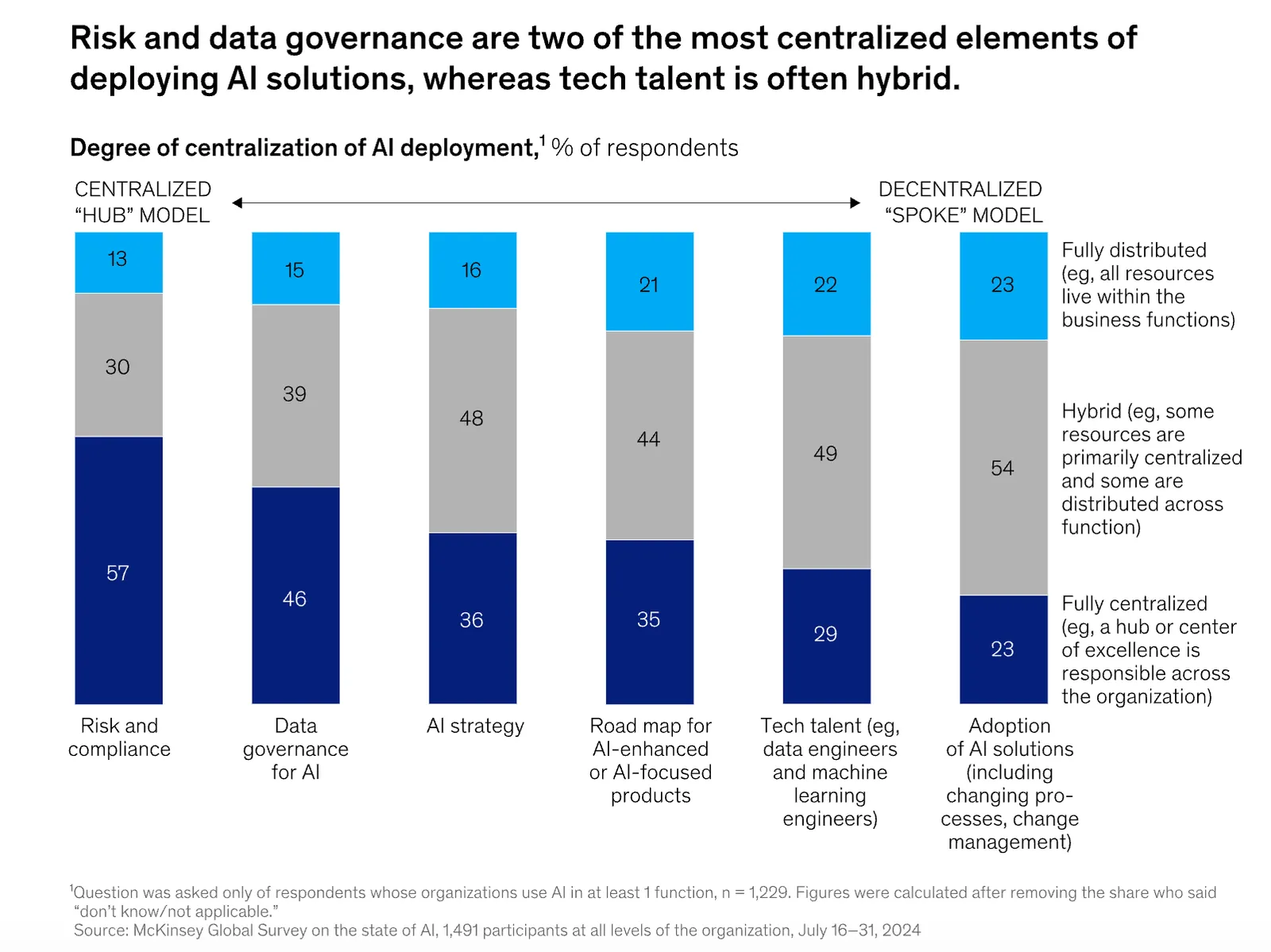
Source: The state of AI: How organizations are rewiring to capture value
AI cost savings
- A majority of McKinsey respondents using generative AI in most functions reported cost reductions; HR had already reached 50% in early 2024. (McKinsey & Company, March, 2025)
- 80% of organizations set efficiency as an AI objective, but high performers more often pair efficiency with growth or innovation. (McKinsey & Company, November, 2025)
Productivity gains
- GitHub Copilot users completed a controlled coding task 55% faster. (GitHub, September, 2022)
- 53% of leaders said productivity must increase, while 80% of workers said they lacked time or energy. (Microsoft, April, 2025)
Time saved
- Time saved only becomes financial value when organizations decide whether to increase output, improve quality, shorten cycle time or reduce labor demand. (McKinsey & Company, March, 2025)
- Developers completed a controlled coding task 55% faster with GitHub Copilot, a concrete time-saving benchmark that still requires a decision about where the released capacity goes. (GitHub, September, 2022)
Revenue impact
- 39% of organizations report any enterprise-level EBIT impact from AI, and most attribute less than 5% of EBIT to it. (McKinsey & Company, November, 2025)
- 17% of organizations in McKinsey’s earlier survey attributed at least 5% of EBIT to generative AI. (McKinsey & Company, March, 2025)
Cost reduction
- GitHub’s controlled experiment found developers completed a coding task 55% faster with Copilot, converting cycle-time reduction into a measurable labor-capacity gain. (GitHub, September, 2022)
- Software engineering, manufacturing and IT report the strongest use-case-level cost benefits in McKinsey’s 2025 survey. (McKinsey & Company, November, 2025)
Payback period
- Nearly three-quarters of Deloitte respondents said their most advanced initiative met or exceeded ROI expectations, despite longer-than-expected time to value. (Deloitte, January, 2025)
A practical payback formula is: implementation cost plus annual run cost, divided by verified monthly savings or contribution margin. Use verified active users and accepted outputs, not purchased seats or generated drafts.
- 70% of organizations expected generative AI investments to reach ROI within two to three years, even as 90% expected implementation to raise IT costs. (Nutanix, February, 2025)
Businesses replacing SaaS with AI
The shift is real, but it is more precise than the headline. Companies are replacing the narrow workflows and internal tools before they replace systems of record.
Source: IBM Study: CEOs Double Down on AI While Navigating Enterprise Hurdles
Companies replacing SaaS with AI
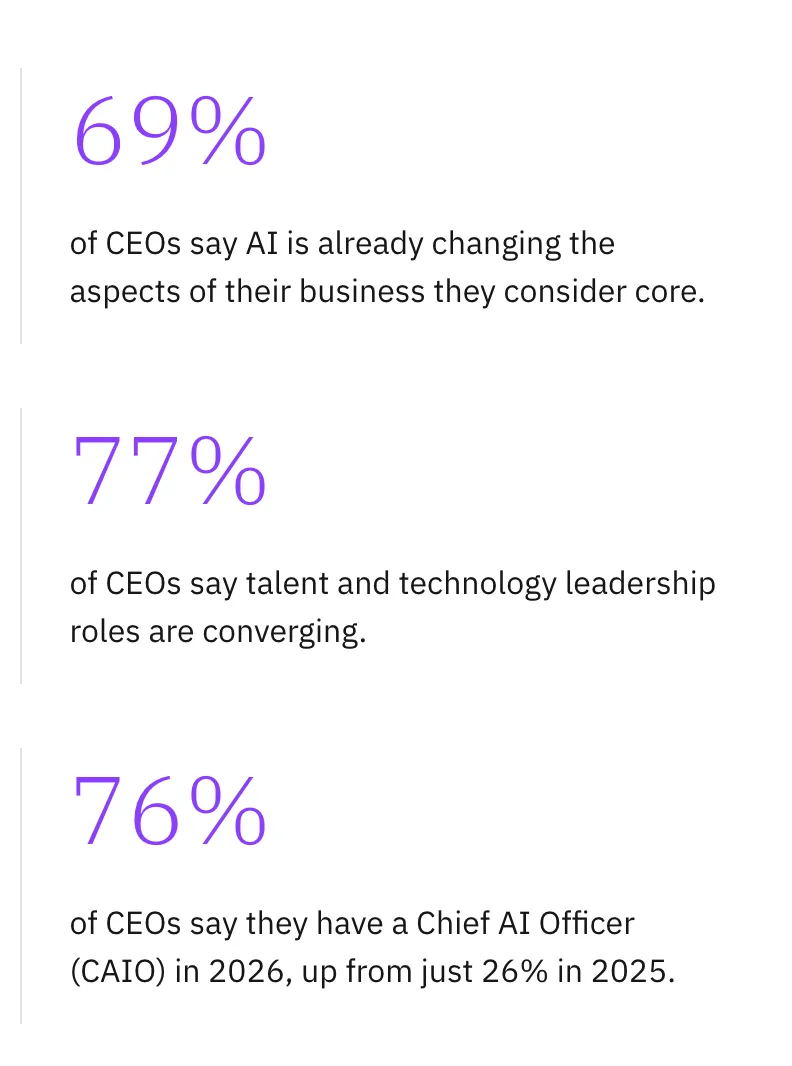
- 50% of CEOs said rapid investment left their organization with disconnected, piecemeal technology, while the expected growth rate of AI investment was set to more than double over two years. (IBM, May, 2025)
- Nearly three in five organizations primarily built their AI stacks with local vendors, evidence that custom and sovereign stacks are becoming a credible alternative to standardized global SaaS. (Deloitte, February, 2026)
- Only 25% of AI initiatives in IBM’s CEO study had delivered expected ROI and 16% had scaled enterprise-wide. (IBM, May, 2025)
AI replacing internal software
- 61% of CEOs said their organizations were actively adopting AI agents and preparing to implement them at scale. (IBM, May, 2025)
- 46% of leaders said their organizations were already using agents to fully automate workstreams or business processes. (Microsoft, April, 2025)
Private AI deployments
- 77% of organizations factor country of origin into AI-vendor selection, and nearly three in five primarily build their AI stacks with local vendors. (Deloitte, February, 2026)
- 63% of organizations used at least one open model in their AI stack, giving private deployments a substantial model base beyond proprietary APIs. (Linux Foundation, May, 2025)
On-premise AI adoption
- 90% of organizations expected GenAI implementation to raise IT costs, 70% expected ROI within two to three years and 98% reported difficulty moving workloads from development to production. (Nutanix, February, 2025)
- Mistral reported that Medium 3 could be self-deployed on four GPUs or more, placing a concrete infrastructure threshold on private inference. (Mistral AI, May, 2025)
Self-hosted LLM growth
- 89% of organizations use some open source in their AI stack, and 63% use at least one open model. (Linux Foundation, May, 2025)
- 60% of surveyed organizations used open-source ecosystems as a source for AI tools, and open-source users reported positive ROI more often than nonusers. (IBM, December, 2024)
Open-source AI adoption
- 51% of companies using open-source AI tools reported positive ROI versus 41% of companies not using open source; 60% used open-source ecosystems as an AI tool source. (IBM, December, 2024)
- 89% of organizations used some open source in their AI stack and 63% used at least one open model. (Linux Foundation, May, 2025)
Enterprise AI purchasing trends
The buying model is changing from one vendor and one model to governed portfolios, task routing and consolidated workspaces.
Source: Gartner Says Worldwide AI Spending Will Total $2.5 Trillion in 2026
Multi-model adoption
- The typical enterprise used about 11 generative AI models, and IBM expects that portfolio to grow roughly 50% by 2027. (IBM, November, 2025)
- Amazon Bedrock supported more than 20 managed models from Amazon and outside providers, enabling customers to test and switch models without rewriting code. (Amazon, February, 2026)
Model switching
- Large input/output price gaps and 50% batch discounts make routing by task, latency and quality a primary cost-control technique. (Google, July, 2026)
- Amazon said Bedrock customers could test and switch among more than 20 managed models without rewriting code, reducing the technical cost of routing changes. (Amazon, February, 2026)
Vendor consolidation
- 50% of CEOs said recent investment had produced disconnected, piecemeal technology, an explicit case for portfolio consolidation. (IBM, May, 2025)
- A single Bedrock layer exposed more than 20 managed models and supported switching without code rewrites, showing how model choice can be consolidated behind one operating platform. (Amazon, February, 2026)
AI procurement priorities
- 77% of companies consider country of origin in AI-vendor selection, while nearly three in five primarily use local vendors, making sovereignty a mainstream procurement criterion. (Deloitte, February, 2026)
- 50% of CEOs said rapid AI investment had produced disconnected, piecemeal technology, while only 25% of initiatives had delivered expected ROI. (IBM, May, 2025)
CIO AI budgets
- 86% of infrastructure decision-makers expect budgets to rise over three years, while many organizations still lack mature cost allocation and value measurement. (Deloitte, April, 2026)
- AI infrastructure spending reached $90 billion in Q4 2025, and IDC projects cumulative spending to exceed $1 trillion through 2029. (IDC, May, 2026)
Expected AI spending in 2027
- Gartner forecasts total AI spending of $3.337 trillion in 2027, including $1.748 trillion in infrastructure, $761.0 billion in services and $636.1 billion in software. (Gartner, January, 2026)
- The 2027 forecast is 32% above 2026 total spending and almost 90% above 2025. (Gartner, January, 2026)
- IDC’s narrower market definition projects global AI spending above $630 billion by 2028, providing an important scope check against Gartner’s broader 2027 total. (IDC, May, 2026)
Methodology
These statistics are designed for citation, comparison and budgeting. Here is how sources, prices and derived calculations were handled.
This page was reviewed in August 2026. It prioritizes primary sources: official pricing pages, company help centers, SEC filings, earnings calls, government and standards bodies, and original surveys from Gartner, McKinsey, Deloitte and Capgemini. IBM Institute data is used only where it adds original operating-cost context.
Prices are listed in US dollars before tax unless the source states otherwise. Subscription prices and API rates can change; quote-based enterprise tiers are labeled as such. API comparisons preserve the provider’s own unit, usually one million tokens, a generated second, an image or a credit, because converting unlike workloads into one “average AI cost” would create false precision.
Editorial rule: a statistic stays only when it helps a reader make a budget, procurement or operating decision. Vanity adoption numbers without cost or value context are excluded.
Your AI bill is not a strategy
The test of your AI investment is not how many tools your company adopts but seeing work becoming faster, simpler, and more valuable.
The problem most companies have is a systems problem: scattered subscriptions, unclear ownership, no usage baseline, and no agreed definition of value.
That is exactly why we built Nexus. It replaces the pile of personal accounts with one private, company-owned workspace grounded in your own business knowledge, with usage tracking built in from day one, starting at $500/month per company regardless of seat count.
At Phos AI Labs, we help $5M+ companies decide what to build, what to buy, and what to leave alone, so that the system is right and no dime goes to waste.
We install the foundations, train the people, consolidate the workspace, and put agents into the workflows where the economics are real.
Should you want to know more, contact us @ Phos AI Labs