Overview
A hospitality group with operations across five countries: Mexico, Colombia, Ecuador, Panama, and the United States. Airports, restaurants, travel retail. A leadership team that had already done the hard work most organizations skip: written governance policies, started internal training at the director level, and built dashboards to track adoption across a multi-country operation.
The CIO had moved faster than most. He had trained directors personally, enforced data governance, and built the measurement infrastructure to see exactly where the organization stood at any given moment. The foundation was real. The opportunity was scaling it.
77% of the team was already using AI every week. The tools were inside the building. The judgment, the governance, and the workflow-level capability needed to match that energy existed at the top. The next step was installing it across every department, in every country, with a system that would hold after Phos AI Labs left the room.
Phos AI Labs structured a six-month engagement around one outcome: an organization that could keep building on its own, with the governance, the platform, the trained teams, and the internal champions to do it.
That is the engagement this case study is about.
The diagnostic
Before designing a single component of the engagement, Phos AI Labs ran a structured diagnostic across the organization. 79 people responded across five countries; operations managers, administrative managers, regional directors, and corporate area leads. 85% of the expected audience. Enough signal to build on.
The headline number set the direction for everything that followed.
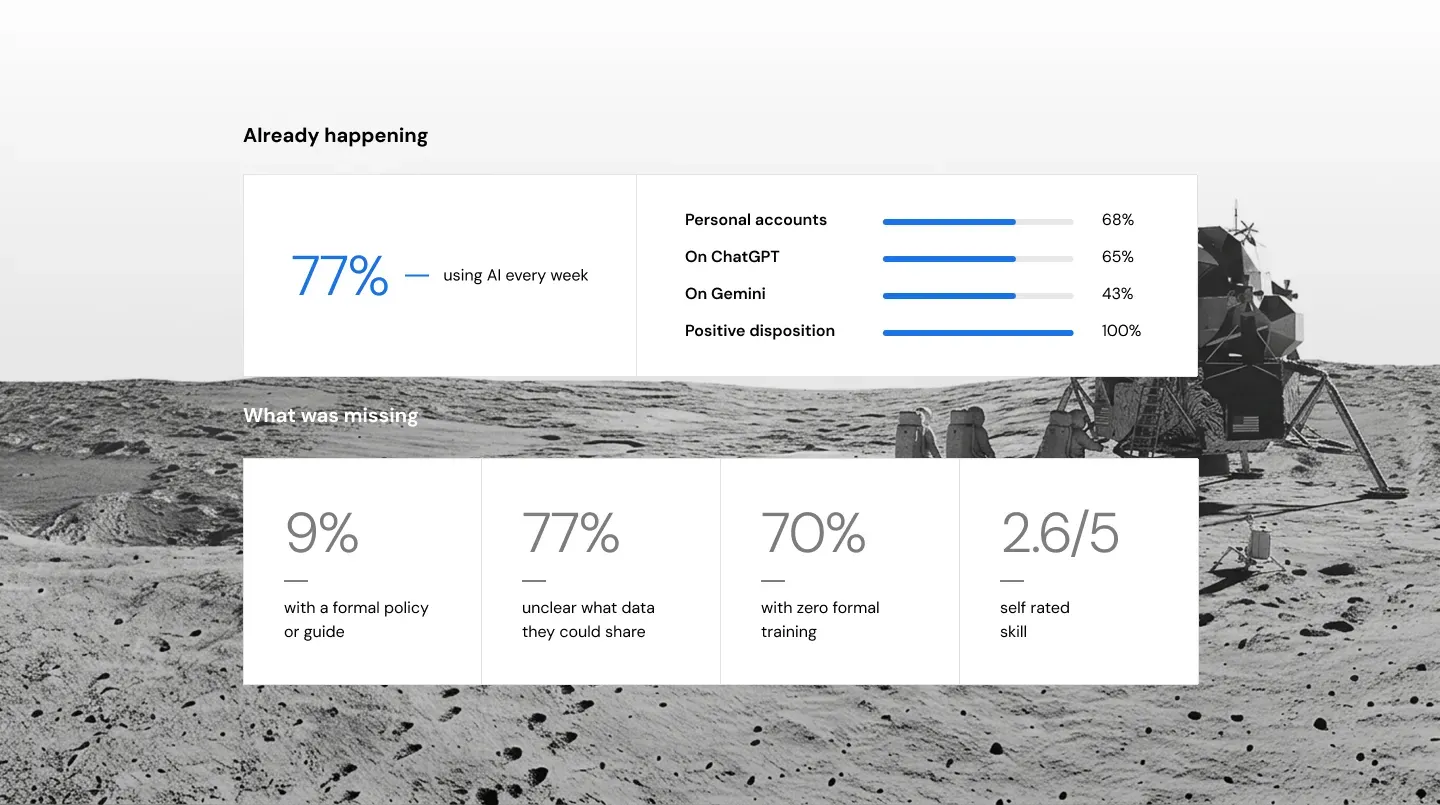
Every week. In their actual jobs. Drafting emails, analyzing sales data, reconciling reports, comparing supplier quotes, reviewing contracts. The energy was real and the use was already happening.
- 68% were using personal accounts
- 65% were on ChatGPT, 43% on Gemini
- Only 9% had any formal policy or guide from the company
- 44% had no clarity on what information they were allowed to share with an AI
100% of respondents had positive disposition toward using AI at work. One person out of 79 said they were not interested.
The organization had momentum. What it needed was the infrastructure to make that momentum compound.
The capability and governance gap.
The diagnostic made the opportunity precise:
- Self-rated skill: 2.6 out of 5
- 70% had received zero formal training from the company
- 48% identified not knowing how to use AI well enough as their primary barrier
- 37% cited data security as their main concern; a specific and legitimate question about what happens when company data moves through a personal account with no rules around it
What the team said they needed to move forward.
When asked what conditions would make them confident in a new technology initiative, the answers were consistent across roles and countries:
- Pilot before scaling
- Clear objectives and measurable results
- Training and ongoing support
- Security and data reliability above everything else
The lesson the organization had collectively carried from previous technology initiatives was precise: “we launched before we were ready.”
That single sentence shaped the sequencing of everything Phos AI Labs designed.
The use cases were already there.
77% of the team was using AI personally every week. One operations manager had already built a workflow to reconcile discrepancies between two reporting systems, detect attribution errors, and produce clean reports for the direction. Real work, real output, real value; running on a personal account with no structure around it.
That was the real starting point. A foundation that already existed, ready to be made visible and useful at scale.
The Objective
With 77% of the team already using AI every week, the engagement had a clear starting point. The work was building the infrastructure that would make that momentum hold.
What the CIO needed was a partner who would stay in the room for six months and build the infrastructure that enthusiasm had been running without: a governance policy built from the diagnostic findings, a single governed platform the whole organization could use safely, department-level training on real workflows, internal champions who could sustain adoption after the engagement ended, and a measurement system that showed whether any of it was actually working.
He wanted to walk away from the engagement with three things.
A governed environment every department could use with confidence. One platform, one set of rules, one place where the organization’s AI work lived and could be seen by the people responsible for it.
A trained organization where department leads could run their own workflows, champions could support their colleagues, and every area owned a playbook it could execute independently.
A measurement system with real targets. Adoption tracked against the diagnostic baseline every 90 days, with specific outcomes the engagement was accountable for delivering: 50%+ of the team with active enterprise accounts, 50%+ using AI every week, and 10+ documented workflows owned by individual departments by month 6.
The goal was an organization that could keep building after Phos AI Labs left the room.
What we built
Phos AI Labs built four things before the first training session ran. The training had a foundation to build on because the infrastructure came first.
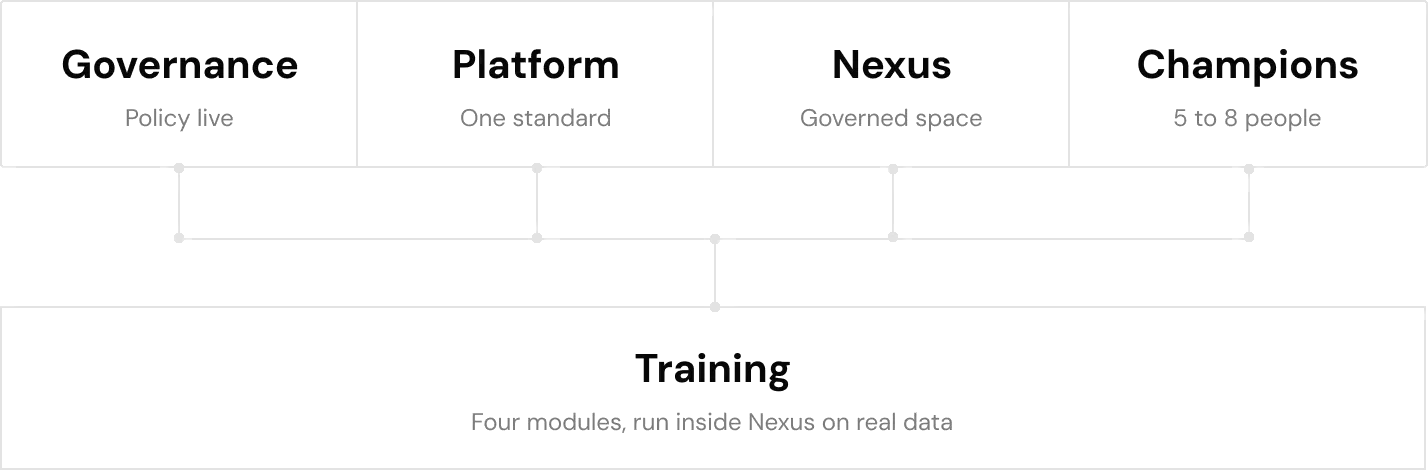
Governance: the rules of the road
The governance policy Phos AI Labs built was constructed from the diagnostic findings and the specific conditions of the organization: multi-country operations across five countries, retail and hospitality data, and systems already in use across different geographies. Every employee left with a clear answer to three questions: what tools are sanctioned, what data can move through them, and who makes the call when something is unclear.
That policy became the permission structure the training needed to work.
Platform selection: one independent recommendation
The organization had employees on ChatGPT, Gemini, Copilot, and Claude simultaneously; each on a personal account, each with different capabilities, different data handling rules, and different costs. The team needed one sanctioned platform that fit what the organization actually required.
The evaluation was independent. Every platform was measured against the same criteria: cost, capability, security compliance across five countries, and integration with the systems the organization already operated on.
Nexus deployment: one governed workspace
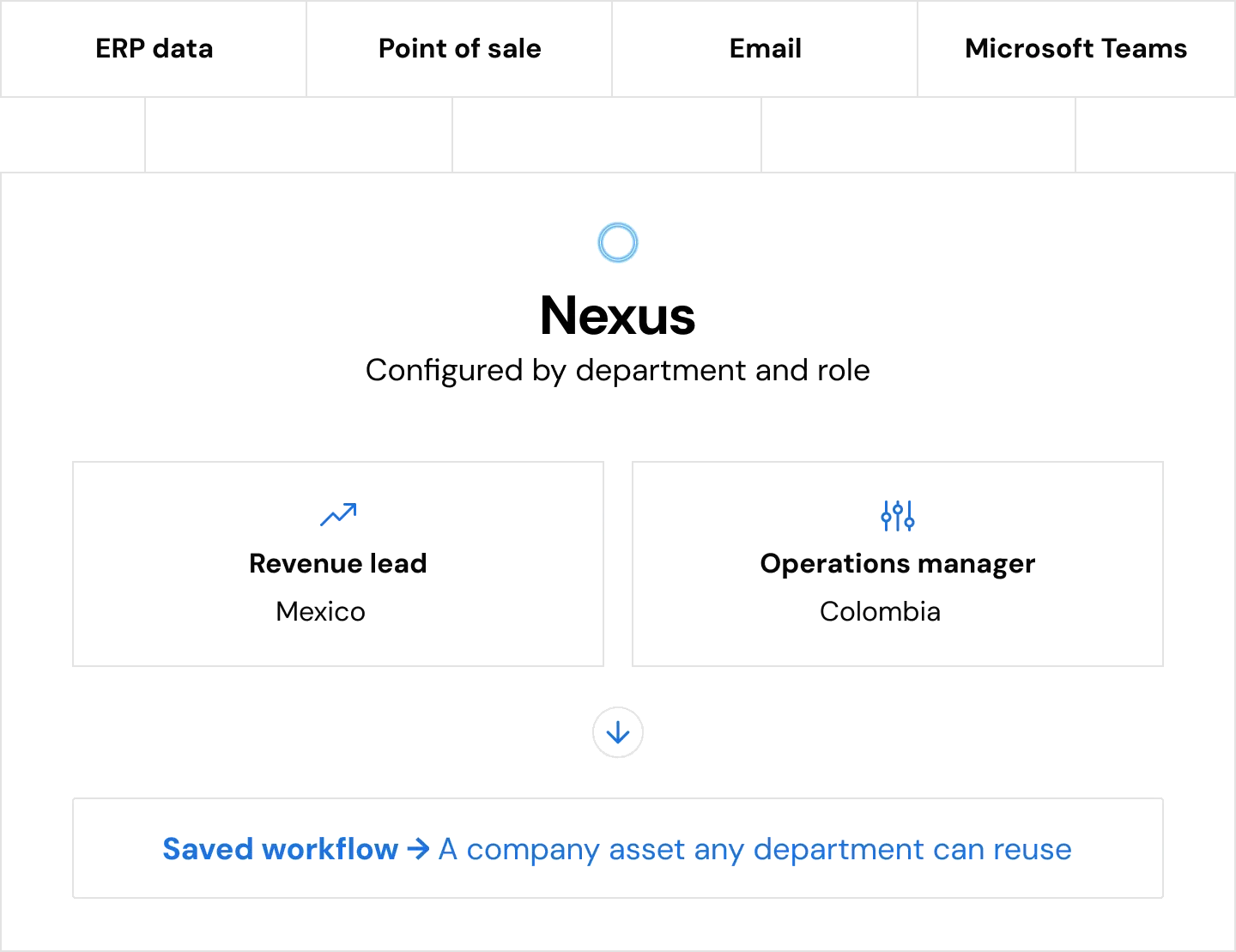
Once the platform was selected, Phos AI Labs deployed Nexus: a private AI workspace wired directly into the organization’s operational stack. ERP data, point of sale figures, email, and Microsoft Teams; all connected, all governed, all accessible from a single workspace configured by department and role. A revenue lead in Mexico and an operations manager in Colombia worked from the same governed environment, pulling from the same live data, producing outputs that lived in the company’s workspace from the moment they were created.
Every workflow saved became a company asset any department could access, update, and reuse.
Phos AI Labs worked directly alongside the IT team to configure and deploy Nexus: clear documentation, defined handoffs, and direct support at every configuration step so both workstreams moved forward on the same timeline.
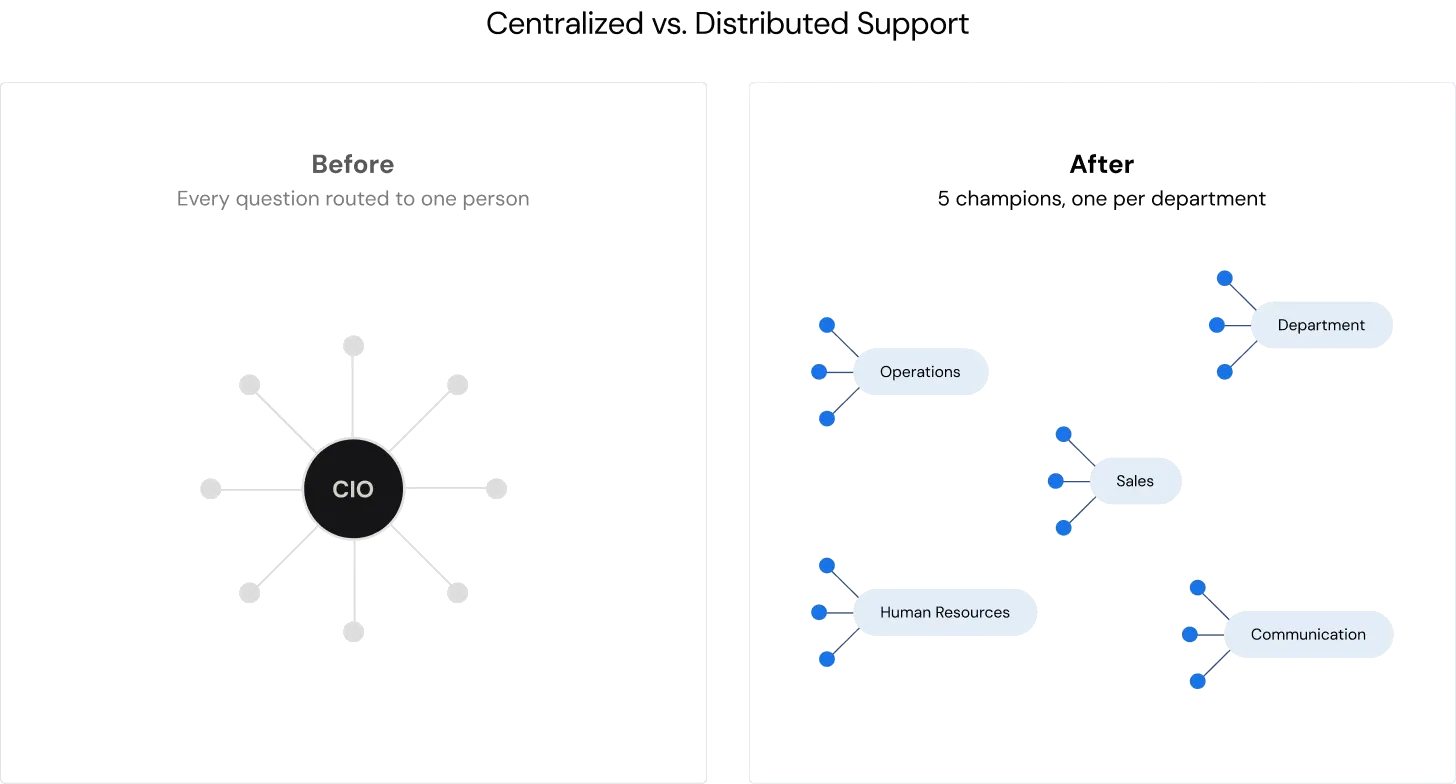
Champions Program: the adoption layer that outlasts the engagement
The diagnostic had identified a specific organizational pattern: good workflows stayed local, knowledge produced by individuals stayed within the team that created it.
Phos AI Labs selected and prepared 5 to 8 people across the organization to become the first point of contact for AI questions in their department. The champions received advanced training, direct access to the Phos AI Labs team throughout the engagement, and the tools to support their colleagues without routing anything back to the CIO or to Phos AI Labs.
The Champions Program had one design intention: when the six-month engagement ended, adoption would not end with it.
How it works
With the governance policy live, Nexus deployed, and champions identified, the training ran inside a governed environment where everything the team produced was owned by the company from the moment it was created.
Phos AI Labs took the four capability gaps the diagnostic had named and built four modules around them. Every exercise ran inside Nexus on real operational data. Every output was saved as a company asset. Every manager left each session with something they could open the next morning and hand to a colleague.
Implementing technology does not automatically improve a process. There is no point automating something we have not first questioned and optimized.
Module 01: From scattered use to a shared standard
65% of the team was already on ChatGPT every week. Module 01 gave that momentum a shared standard: one governed workspace, one set of sanctioned tools, and a live session where every manager produced something real with their own operational data.
- Operations managers uploaded 12 months of their own occupancy and sales data, ran a live trend analysis, and extracted pattern-based pricing recommendations; saved inside Nexus as a reusable workflow for the next cycle
- General managers built a competitive benchmark report with verified sources, formatted for a director-level audience; saved as a company template anyone on the team could run the following week
- Area directors produced an executive summary from raw operational context in under five minutes; the prompt, the format, and the output saved as a company asset inside Nexus
Every manager left Module 01 with three working outputs built on their own data, saved in the company’s workspace and ready for the next person to use.
Module 02: Operations and people management
39% of the team spent more than 40% of their week on manual, repetitive work. Reporting, documentation, coordination, and communication were the heaviest tasks. Module 02 was built around those specific workflows, with every output saved inside Nexus so the work would survive beyond the person who first built it.
- HR leads built complete onboarding SOPs for their departments, translated into three languages, saved inside Nexus as living documents any HR manager across any country could access, update, and use
- Operations managers loaded internal policy documents into Nexus and built a structured knowledge base; any manager on any shift could ask a question and get the answer with the exact source reference attached, without opening a second system
- HR workflows inside Word and Excel, from drafting job postings to structuring training plans, were rebuilt as saved Nexus workflows that run in days instead of weeks
- Guest experience managers built a full recovery protocol for negative TripAdvisor reviews, including sentiment analysis and a brand-aligned response; saved as a company standard any location could follow in real time
The result was a set of workflows the team could replicate the next morning in their own operation, owned by the company, visible to every department that needed them.
Module 03: Revenue, pricing, and competitive strategy
Revenue and sales management was the area the team considered most critical to the business. It was also the area where manual work was most concentrated, and where the cost of inconsistent output was highest. Module 03 addressed both simultaneously.
Every exercise ran on real operational data loaded into Nexus. Every output was saved as a company asset, ready to use at the next commercial committee or director-level review.
- Revenue leads built a three-scenario rate matrix using their own historical occupancy and tariff data; saved inside Nexus as a reusable pricing model for every commercial cycle
- General managers produced a verified competitive analysis of new market entrants in their zone, formatted for a director-level presentation with sources attached; saved as a template any GM across any country could run independently
- Marketing managers designed pre-arrival and post-stay email sequences segmented by guest type: business, leisure, and group; three complete flows saved inside Nexus and ready to activate across every location
- F&B managers uploaded their menu and ingredient costs, analyzed margins by dish, and produced an optimized menu recommendation with revenue projections; saved as a living document updated every cycle
I used AI to analyze and compare daily sales figures across locations, detect discrepancies, correct attribution errors, and produce clean reports for the direction.
Module 04: Build the AI playbook for your operation
The diagnostic had surfaced a specific organizational pattern: good workflows stayed within the teams that built them. The processes that worked in one department never reached the others. Module 04 was designed to change that architecture permanently.
Everything built across the first three modules came together into a single deliverable: a 90-day AI playbook for each area, documented inside Nexus with assigned owners, defined metrics, and quick wins for the first two weeks.
- Procurement and technology leads evaluated vendors using real market data and built a structured assessment matrix with costs and a justified recommendation; saved inside Nexus as the company’s vendor evaluation standard
- Area directors built a business case for AI investment in their department, including ROI projections, investment ranges, KPIs, and a 90-day timeline; saved as a living document updated each quarter
- Every manager structured their final deck inside Nexus: roadmap, investment, and first milestones, ready to present to their direction the following week
The playbook gave each area a defined starting point, a measurable plan, and a reason to keep going. Every workflow documented. Every owner named. Every next step owned by the department, ready to run without routing anything back to the top.
The outcome
Before Phos AI Labs came in
- 77% of the team was already using AI every week, across personal accounts on ChatGPT, Gemini, and Copilot
- 0% had active enterprise accounts inside a governed environment
- Recognized company-wide use cases: one department, Marketing and Design
- Self-rated skill across the organization: 2.6 out of 5
- 70% had received zero formal training
- Every AI decision, question, and workflow improvement routed through the CIO
After
- Enterprise accounts active inside Nexus across every department, measured against the 50% adoption target
- 10+ documented workflows saved inside Nexus, owned by individual departments, and replicable by anyone on the team
- Champions active in every department with a structured support system to sustain them
- Every department had a documented 90-day playbook with defined workflows, assigned owners, and measurable quick wins
- Decisions that had required escalation were made locally, with data, by the person closest to the operation
- Usage dashboards visible to every department lead showing exactly who was using AI, on what, and how often
The metric that mattered most to leadership was how many people stopped waiting for permission to use AI well. Nexus made that number visible every week.
Phos AI Labs built the layer that converts a rollout into an institution. The CIO had already done the hardest part: governance policies, director-level training, and the measurement infrastructure to track adoption with precision. What was missing was the system underneath that could scale what he had already proven worked at the top. That is the system Phos AI Labs installs.
How adoption was measured
From the first week of the engagement, Phos AI Labs established a measurement baseline from the diagnostic. Adoption was measured on one axis every 90 days: whether people were using AI in their actual work, inside the company’s own governed environment, every week.
The three targets the engagement was built around:
- 50%+ of the team with active enterprise accounts inside Nexus by month 6
- 50%+ using AI every week on real work, measurable through Nexus usage dashboards
- 10+ documented workflows owned by individual departments, saved inside Nexus, and replicable by anyone on the team
These were the specific, measurable outcomes the engagement was designed to produce, with Phos AI Labs’ fees tied to delivering them.
What’s next
The six-month engagement was one phase of a larger architecture.
The 90-day playbooks each department built, the workflows saved inside Nexus, and the champions activated across five countries are the foundation. Every documented workflow creates the conditions for the next phase: agents and automation running in production, connected to the systems and data the organization already operates on, doing the work that currently requires a person to initiate it.
Phos AI Labs works across the full sequence:
- Phase 01 · AI Consulting: map where the organization stands, identify the highest-value opportunities, and build the governance foundation before anything goes into production
- Phase 02 · AI Enablement: deploy the governed workspace, train department by department, activate champions, and measure adoption against a real baseline until the organization can move without external support
- Phase 03 · AI Implementation: design and deploy agents, automations, and AI workflows on top of a team that already knows how to use them; pricing models running on real data, reporting that generates itself, operations that move without waiting for a single person to approve the next step
The organizations that compound fastest are the ones that build in sequence. Each phase creates the conditions the next one needs to hold.
If the pattern in this case study looks familiar; a leadership team that has moved faster than the rest of the organization, licenses paid for and underused, adoption stalling below the director layer; the next step is a direct conversation about where your organization stands and what the right entry point looks like.
Phos AI Labs builds the system that makes an entire AI program stop depending on one person to function.