The problem
In February, the brand restocked its best-selling cast-iron skillet. 4,200 people were on the waitlist. The restock email was supposed to go out the morning the stock landed.
It went out six days later. The content manager was cutting launch videos for TikTok that week, and the email sat half-written in Klaviyo. Only 9% of the waitlist bought.
The restock before that had gone out the same day and converted 31% of its waitlist. The gap on the skillet was about 920 orders, or roughly $72,000 at the average order value.
Nobody on the team was careless. One content manager owned the newsletter, the social calendar, and short video on three channels. Every channel worked when her week went well. Every launch depended on one person’s calendar.
Where Phos AI Labs came in
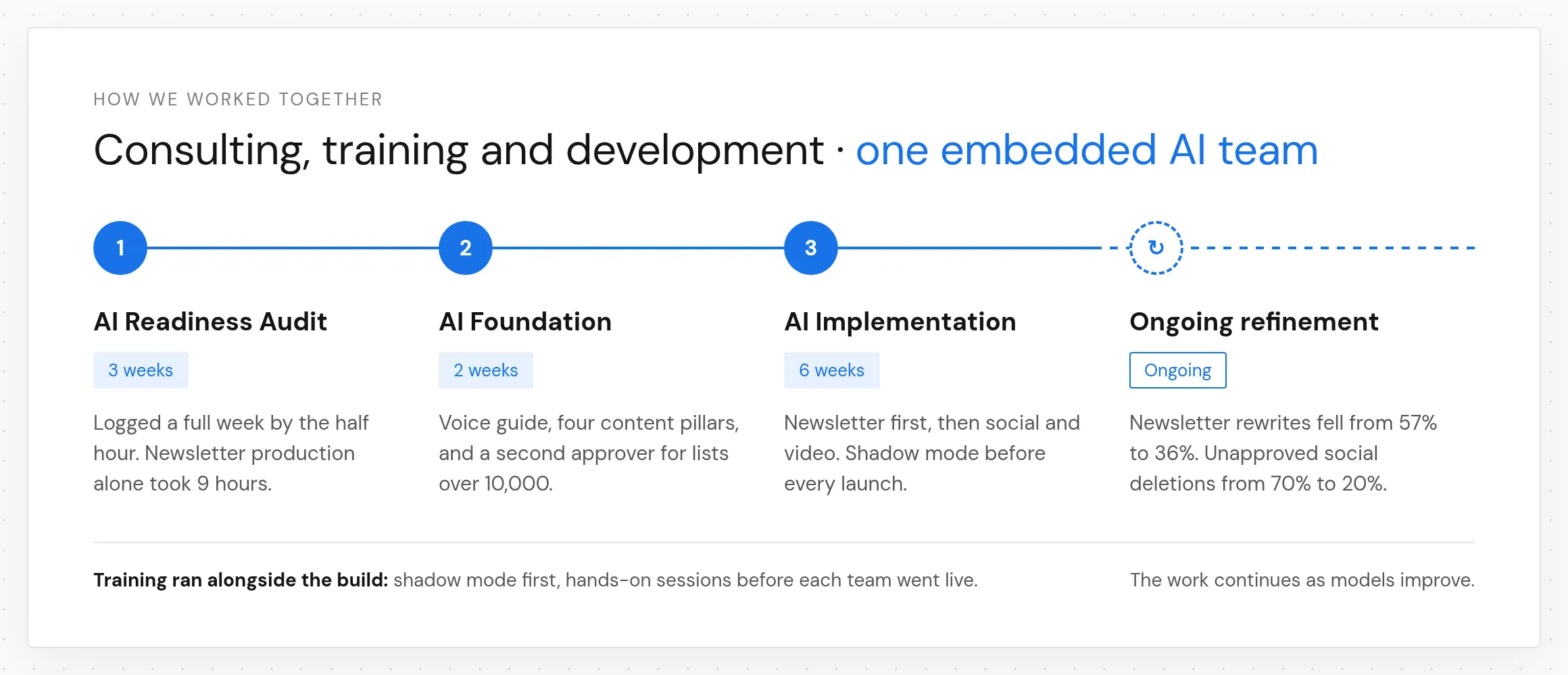
Phos AI Labs started with a three-week AI Readiness Audit. We interviewed the content manager, the Head of Marketing, the e-commerce manager, and the two customer service leads who hear what buyers ask about.
We shadowed the content manager for a full week and logged every task by the half hour. Newsletter production alone took 9 hours. Answering data questions from colleagues took another 4.
Then we read the data. We pulled 18 months of Klaviyo campaigns, a year of Shopify orders, the Publer post history, and the analytics in Search Console, GA4, PostHog, and Clarity.
Three findings shaped the rest. Newsletter weeks outsold quiet weeks by a wide margin. The best content ideas lived in customer calls and support emails that nobody mined. And the video queue ran empty five weeks out of every thirteen.
The baseline
We put a number on each problem before we suggested a fix. The Head of Marketing signed off on each one, and they became the scoreboard for the engagement.
| KPI | Baseline |
|---|---|
| Newsletters sent per month | 2 |
| Weekly hours on newsletter production | 9 |
| Email-attributed revenue per month | $96,000 |
| Social posts published per week | 4 |
| Weeks the video queue ran empty, per quarter | 5 of 13 |
| Median wait for an answer to a data question | 2 days |
| Launch and event emails sent on schedule | 4 of 9 |
The last row stung the most. Five of nine launches and workshops in the prior year had a late or missing email. Each one was a sale the brand had already paid to set up.
Setting the foundation
The AI Foundation phase took two weeks. We sat with the content manager and the Head of Marketing and wrote down the brand voice, which until then had lived in one person’s head.
The voice guide covers tone, banned phrases, how the brand talks about cast iron care, and 30 past newsletters marked as good, fine, or off. We added four content pillars and a list of claims the brand never makes, like health benefits.
We wrote the approval rules into the same document. Drafts and approvals only: nothing publishes or sends on its own. Any email to more than 10,000 people needs the Head of Marketing as a second approver.
Deciding what to build
With the baseline and the voice guide in hand, the Phos AI Labs engineering team joined the account. Their job was to decide what kind of system each problem needed.
We ruled out two common options first. A generic AI writing tool would produce copy that sounded like every other brand. A fully automatic social scheduler would post on a holiday weekend with nobody watching the comments.
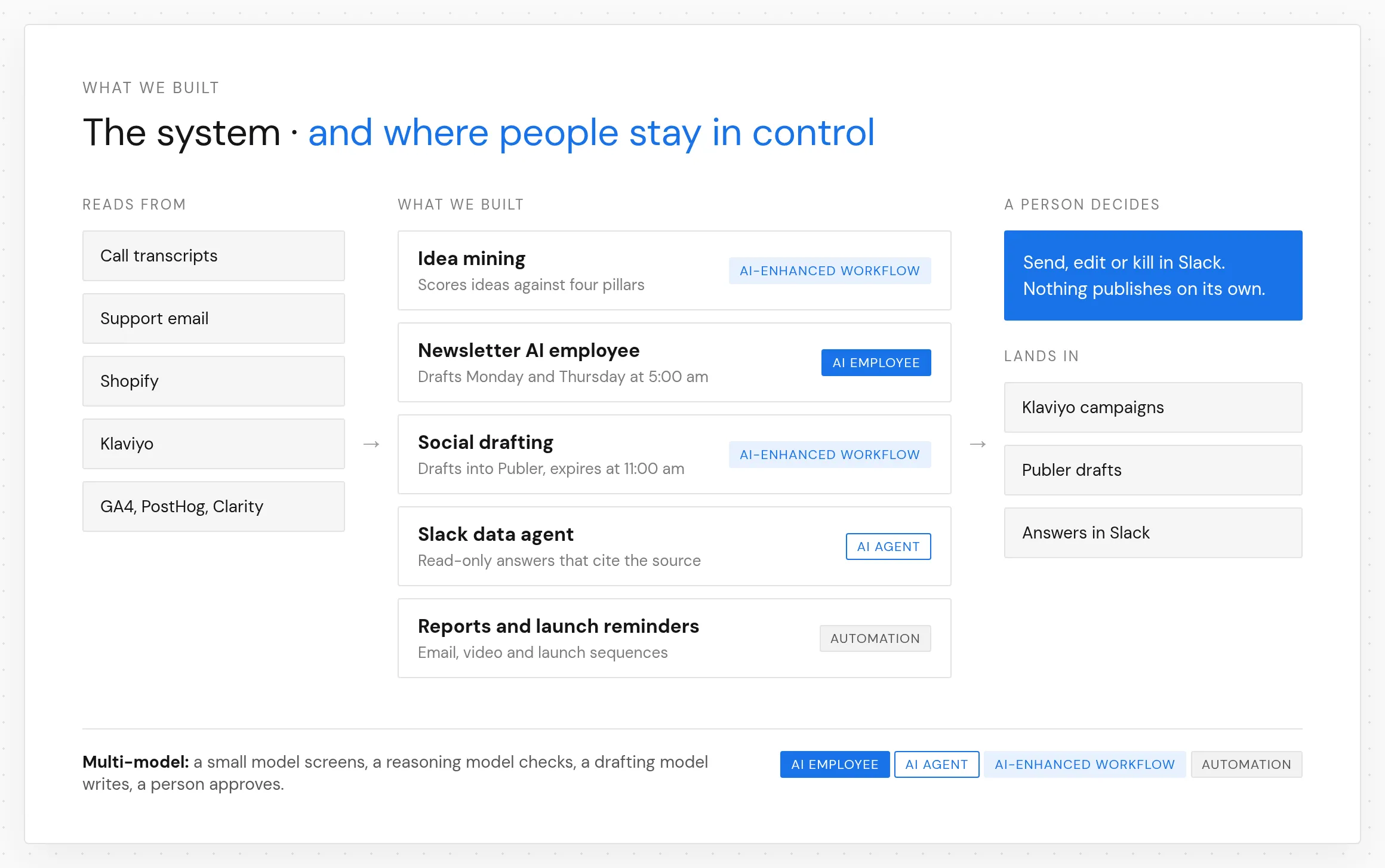
So we matched the tool to the job. The weekly email report, the video review, and launch reminders follow the same steps every time, so they became automations.
Social drafting and idea mining are existing work with one judgment call inside, so each became an AI-enhanced workflow. The Slack data agent reasons over analytics and returns an answer, so it became an AI agent.
Only one job needed an AI employee: owning the newsletter end to end. The job covers choosing the stories, writing in the brand voice, building the email, asking for approval, and learning from every edit the content manager makes.
The build
The build ran six weeks. Idea mining came first, because the newsletter needed raw material. Every morning at 6:30 am, it reads the previous day’s Zoom call transcripts, support emails in Gmail, and links the team saved.
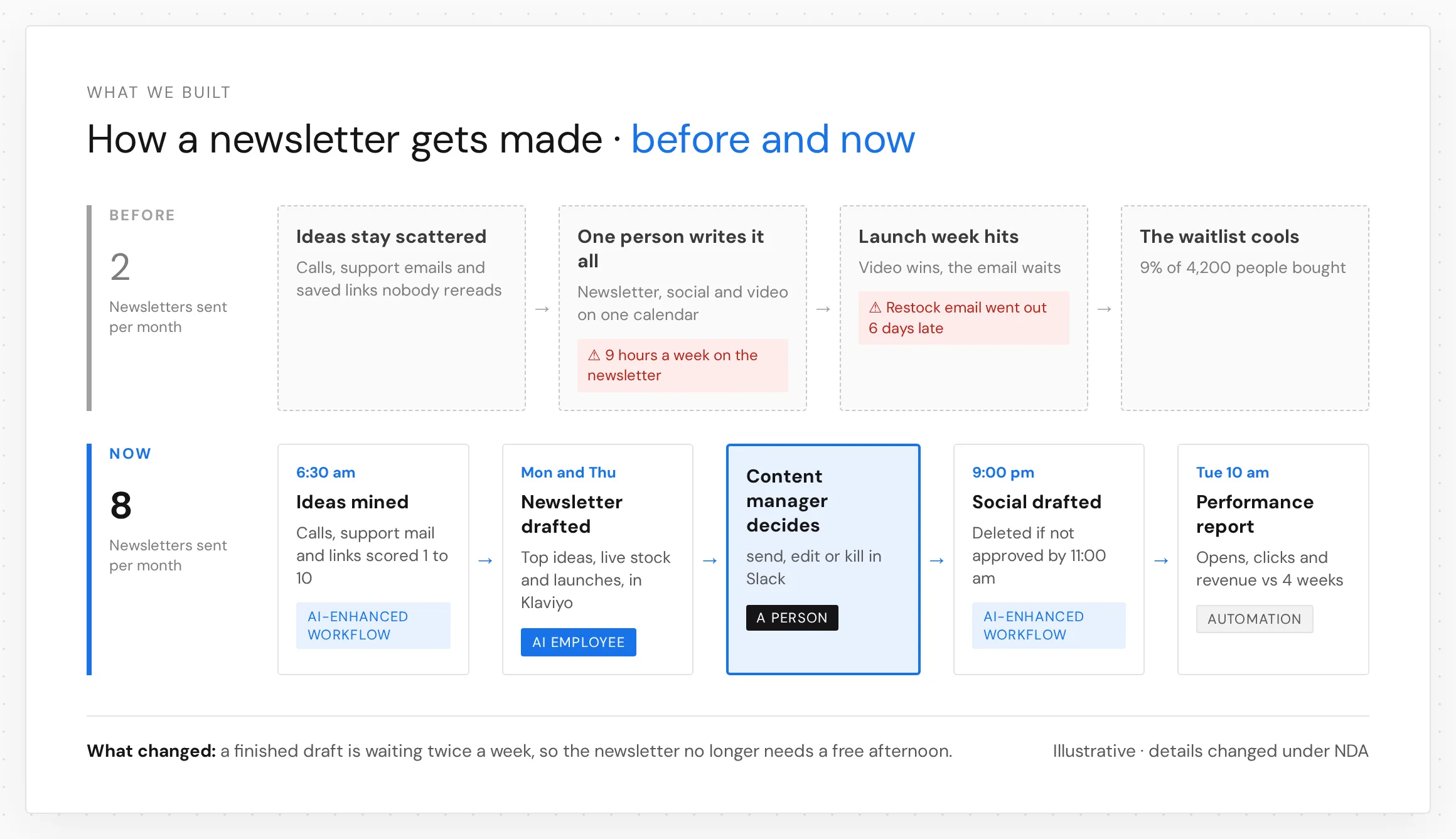
A small, fast model scores each item against the four pillars and drops it into a shared idea board with a one-line angle. Anything scoring below 6 out of 10 is archived, so the board stays short enough to read.
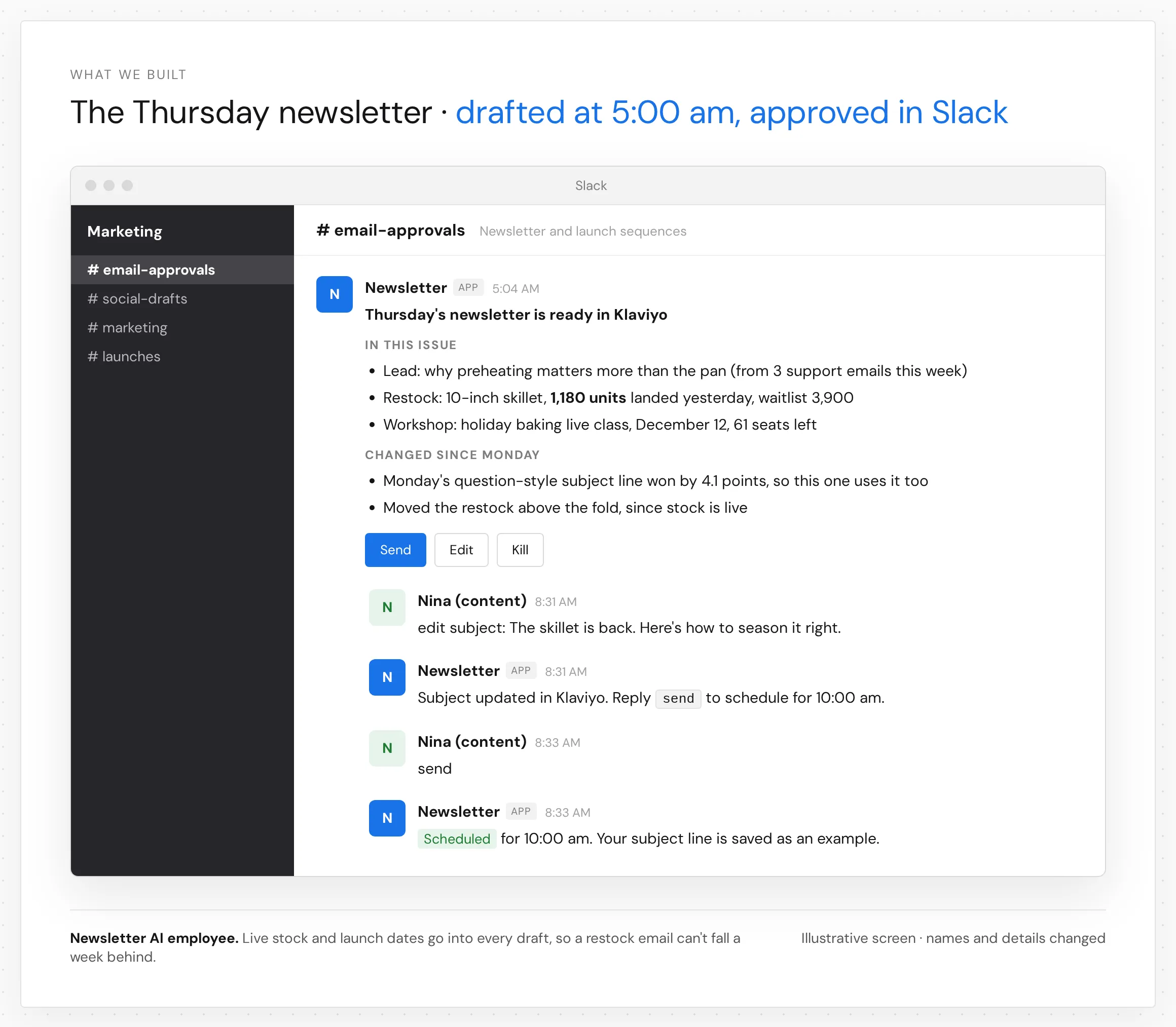
The newsletter AI employee runs Monday and Thursday at 5:00 am. It pulls the top ideas, current Shopify stock, and upcoming launches, then drafts the full email in Klaviyo from the voice guide.
Each run ends with an approval request in Slack. The content manager replies send, edit, or kill. Every edit is saved as an example, and the Thursday draft also carries notes on what changed since Monday.
The email performance report is an automation. Every Tuesday at 10:00 am, it pulls opens, clicks, and attributed revenue from Klaviyo and posts them to the marketing channel next to the prior four weeks.
Social drafting runs at 9:00 pm for the next day. A drafting model writes posts into Publer as drafts only. If nobody approves a post by 11:00 am, the workflow deletes it, so stale drafts never pile up.
The video review automation runs every Monday across TikTok, Instagram Reels, and YouTube Shorts. It reports views, watch time, and saves per video. When fewer than five videos are scheduled for the next two weeks, it sends the content manager a reminder.
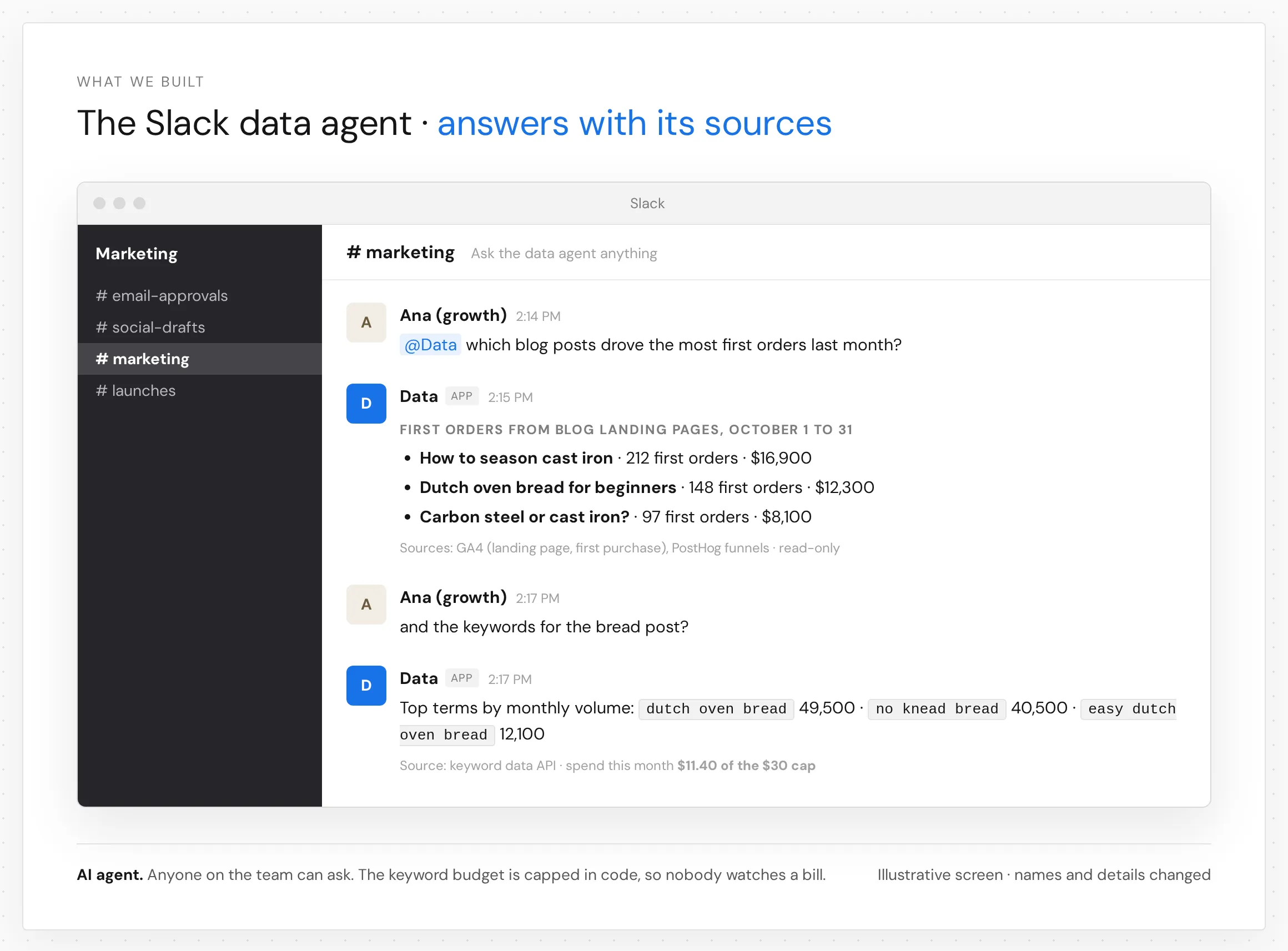
The Slack data agent answers questions from anyone on the team. It reads Search Console, GA4, PostHog, and Clarity with read-only keys, and every answer cites the report and date range it used.
For keyword questions, the agent calls DataForSEO. A spending cap inside the code stops calls at $30 a month, and the ledger resets on the first. Nobody has to watch a bill.
Launch reminders are automations built in Klaviyo. When a launch or workshop goes on the calendar, a sequence is created at 7 days, 1 day, and 1 hour out. The content manager approves the sequence once, when it is created.
The design is multi-model. A small, fast model scores ideas and routes data questions. A stronger reasoning model reads analytics. A drafting model writes in the brand voice, and a person approves everything a customer sees.
Matching model to task kept running costs under $450 a month, keyword data included. Any single model can be swapped when a better one ships, without rebuilding the rest.
Rollout and training
The first version ran in the background. For the last two weeks of the build, everything ran in shadow mode. The newsletter AI employee drafted emails nobody received, and the content manager compared them against her own.
The comparison was the first round of training. She marked what sounded right and what sounded off, and those notes went straight into the voice guide before go-live.
Go-live started in week seven with the newsletter and the Tuesday report. Social drafting and the video review joined in week nine, after a two-hour hands-on session where the marketing team approved, edited, and killed live drafts.
A separate 45-minute session taught seven people outside marketing to ask the data agent questions and check the source it cites. The content manager now owns the voice guide, so updates no longer wait on Phos AI Labs.
Making it better
The first two weeks were rough. The content manager rewrote 57% of newsletter drafts. The two most common fixes were length and tone: drafts ran long, and they pushed the sale too early.
We fixed both at the source. The voice guide now caps the newsletter at 350 words and puts the product mention after the story, the way her best past issues did.
Social drafting had a different problem. In week one, 70% of drafts were deleted unapproved, because the team never opened Publer before 11:00 am. We moved the approval request into Slack, and deletions dropped to 20%.
The data agent made one real mistake. It answered a traffic question with GA4 numbers from the wholesale site. We locked it to the consumer property and added the property name to every answer.
In month three, a newer drafting model came out. We ran it against 40 past newsletter topics, and the Head of Marketing rated both versions blind. She preferred the new model 29 times out of 40, so we switched.
Every two weeks, the marketing team and Phos AI Labs meet for thirty minutes. We review the edits, update the voice guide, and decide what to tune next. By week twelve, 64% of drafts went out with light or no edits.
The outcome
In September, the skillet restocked again, this time with 5,100 people on the waitlist. The reminder sequence had been approved two weeks earlier, when the stock date landed on the calendar.
The restock email went out at 7:00 am, the morning the pallets arrived. The content manager approved it from her phone in three minutes. Within 48 hours, 29% of the waitlist had bought.
Weeks like that are now normal. The content manager starts Monday and Thursday with a finished draft, and spends the hours she got back filming.
| KPI | Baseline | After 90 days |
|---|---|---|
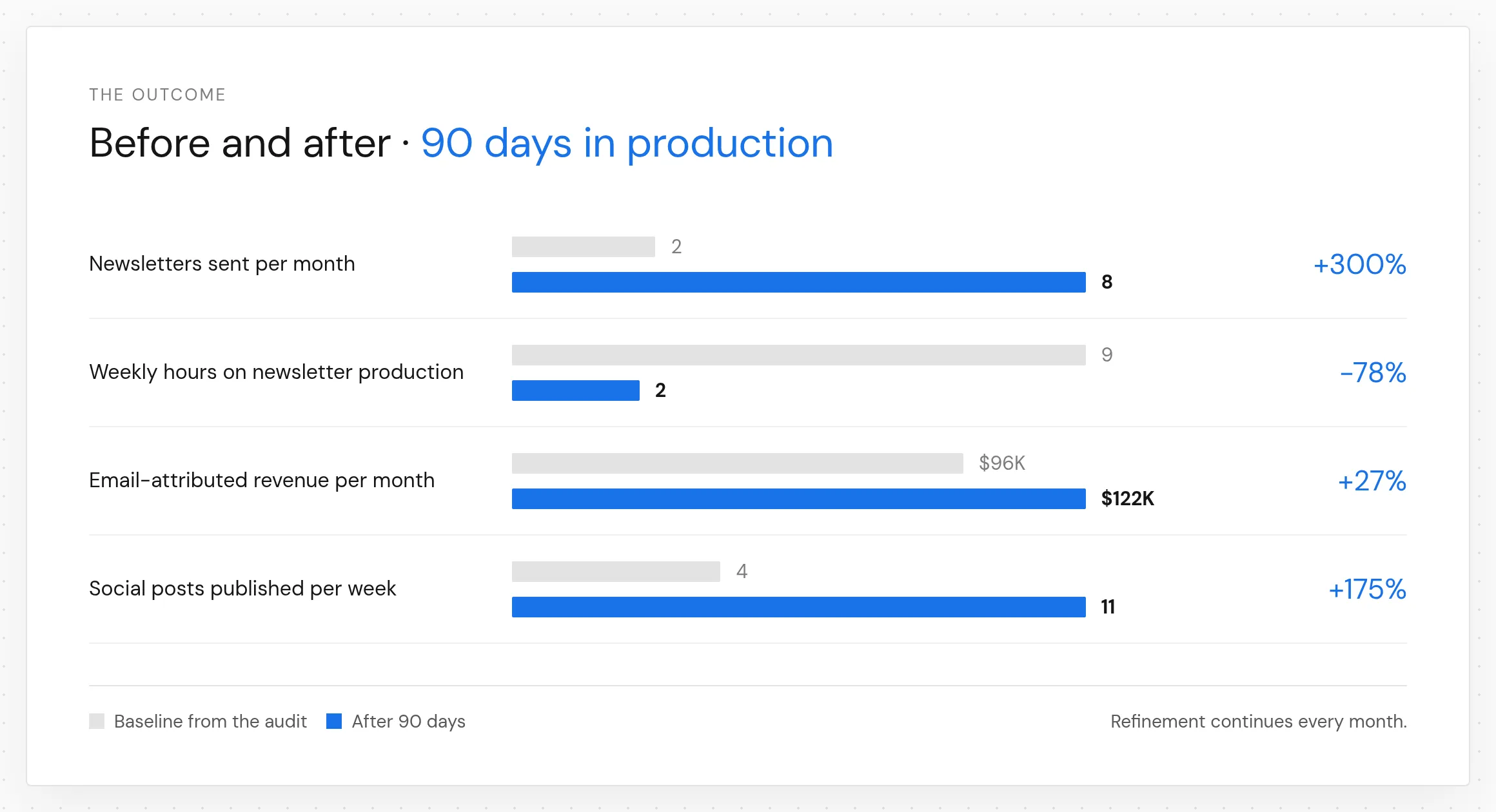
| Newsletters sent per month | 2 | 8 |
| Weekly hours on newsletter production | 9 | 2 |
| Email-attributed revenue per month | $96,000 | $122,000 |
| Social posts published per week | 4 | 11 |
| Weeks the video queue ran empty, per quarter | 5 of 13 | 0 of 13 |
| Median wait for an answer to a data question | 2 days | 5 minutes |
| Launch and event emails sent on schedule | 4 of 9 | 6 of 6 |
| Newsletter drafts sent with light or no edits | n/a | 64% |
Idea mining added a source nobody expected. Four of the eight best-performing newsletters in the quarter started as a question a customer asked on a support call.
I stopped dreading Thursdays. The draft is there, it sounds like us, and I decide what goes out.
What’s next
The project doesn’t have an end date. Each approved edit sharpens the voice guide, and each new model generation writes closer to it. We retest every model release against the same 40 topics before switching.
Next, idea scoring will include Shopify sales, so ideas are ranked on revenue as well as clicks. The target is 10 newsletters a month and email-attributed revenue up 40% over baseline by the end of next quarter.
If one person carries your content calendar, Phos AI Labs can map what that calendar costs and what a second set of hands would change.
Client details changed under NDA.