The problem
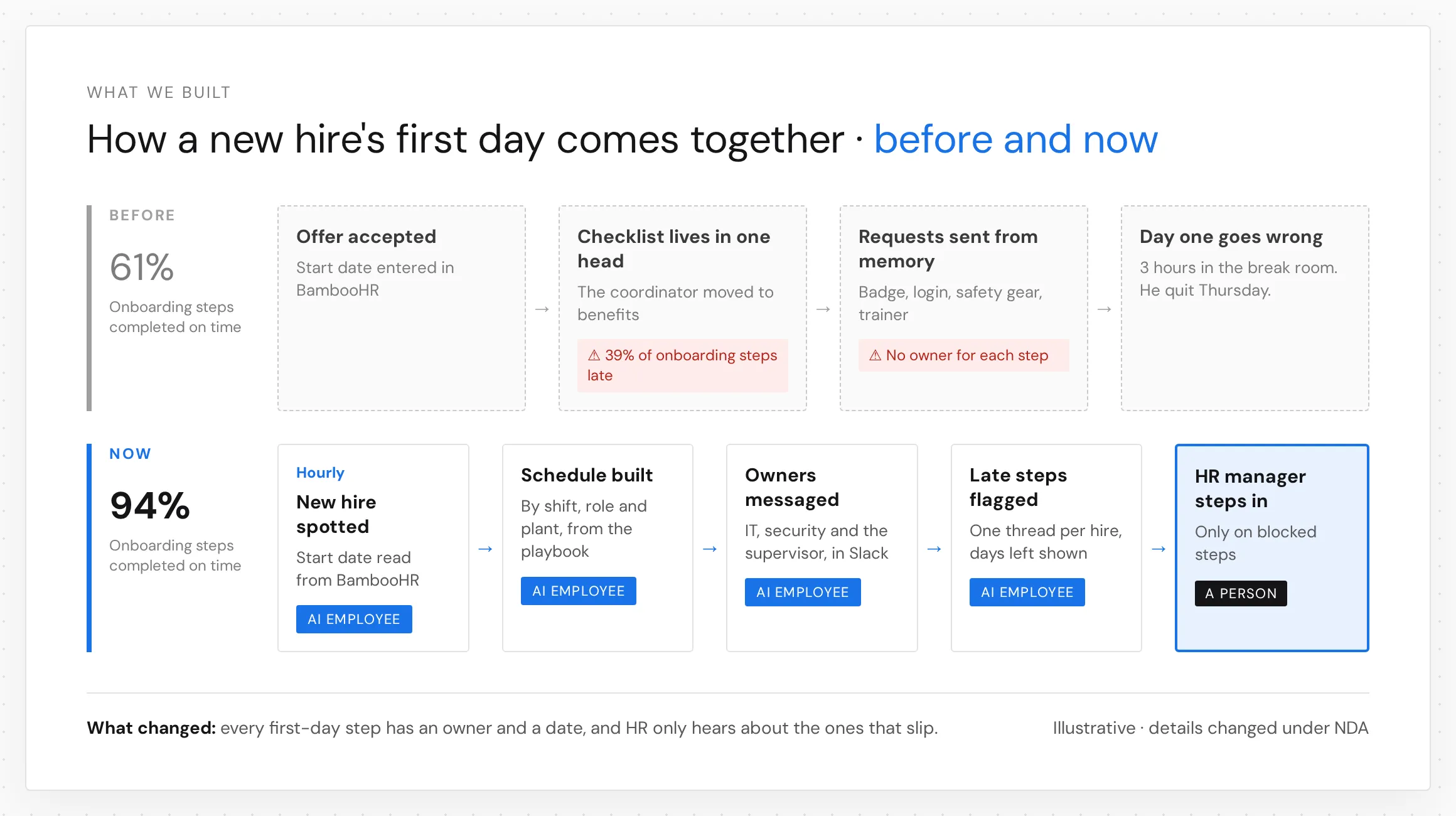
On a Monday in January, a new machine operator showed up at the plant gate at 5:45 am for his first shift. The guard had no badge for him. Nobody on the floor knew his name.
He sat in the break room for three hours. His login to the time clock didn’t exist, his safety glasses hadn’t been ordered, and the trainer was on vacation. HR found out at 9:00 am, when his supervisor called asking who he was.
He quit on Thursday. The company had spent $4,200 recruiting him, and the plant was hiring 70 people that year to keep up with two new contracts.
The HR coordinator who used to handle first days had moved to benefits in the fall. The checklist lived in her head. Finance and IT had the same pattern: one person, one routine, no backup. Every routine worked until the one person who ran it got busy.
Where Phos AI Labs came in
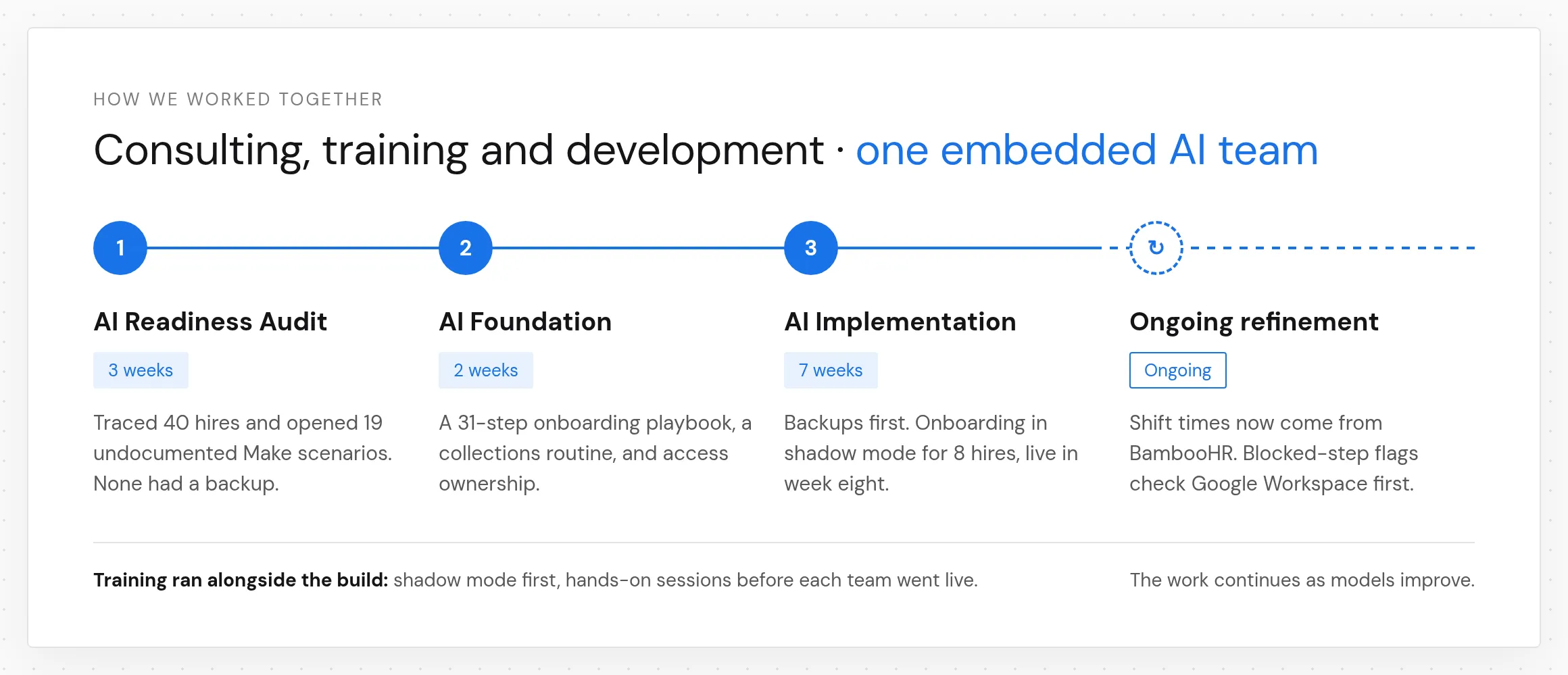
Phos AI Labs started with a three-week AI Readiness Audit. We interviewed the HR manager, both HR coordinators, the controller, the accounts receivable clerk, the IT manager, the plant manager, and three shift supervisors.
Then we read the records. We traced the last 40 hires through BambooHR, email, and supervisor texts. We pulled six months of invoices from QuickBooks, a year of card statements, and the user lists from 14 business tools.
We also opened the 19 Make scenarios a former contractor had built. Nobody on staff knew what half of them did, and none had a backup.
Three findings shaped everything after. Onboarding failed on handoffs between HR, IT, and the floor. Overdue invoices got chased only when the controller had a free afternoon. And nobody owned the list of who could log into what.
The baseline
We started by measuring. The numbers became the scoreboard for the whole engagement.
| KPI | Baseline |
|---|---|
| Onboarding steps completed on time | 61% |
| New hires who left in the first 30 days | 6 of 40 |
| Average days to collect an invoice | 23 |
| Invoice dollars more than 60 days overdue | $612,000 |
| Software subscriptions without an owner | 17 of 63 |
| Active accounts belonging to people who had left | 23 |
| Back-office hours per week on routine chasing | 22 |
The 23 accounts worried the IT manager most. Three belonged to people who had left on bad terms, and one still had access to the shared drive with every customer drawing.
Setting the foundation
The AI Foundation phase took two weeks. We sat with HR, finance, and IT, one team at a time, and wrote down the routines each person had been carrying in memory.
The onboarding playbook lists 31 steps, from offer signed to day 30. Each step has an owner, a due date counted from the start date, and the message the new hire should get. Badge, time clock login, safety gear, and trainer booking must be done by the Thursday before day one.
The collections routine sets when a reminder goes out, when the controller calls, and which customers she handles personally. Anything over $50,000 or any customer older than ten years stays with her.
The access policy names an owner for every tool and says accounts close within one business day of a departure. We wrote the approval rules into the same document. No account is closed, no subscription is cancelled, and no live workflow is edited without a named person approving it.
Deciding what to build
With the baseline and the playbook in hand, the Phos AI Labs engineering team joined the account. Their job was to decide what kind of system each problem needed.
We looked at two common options first. An HR onboarding suite would add a new login for 240 people and still depend on someone updating it. A general AI assistant with admin rights could close the wrong account on a Friday night.
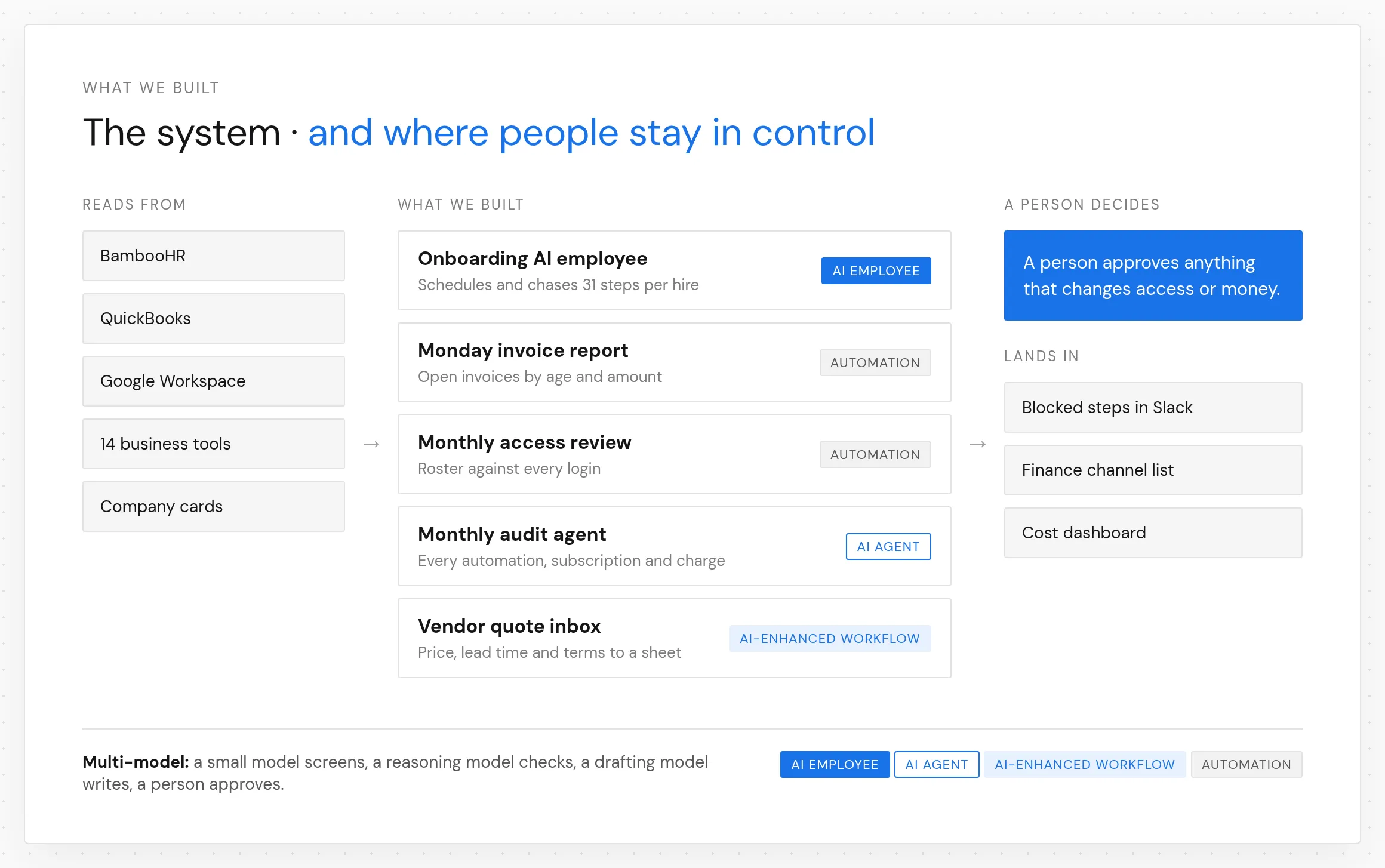
So we matched the tool to the job. Reports and checks that run the same way every time became automations. One judgment call inside an existing process became an AI-enhanced workflow. Reasoning over messy data with a narrow action became an AI agent.
Only one job needed an AI employee: owning onboarding end to end. The role covers reading the playbook, sending each new hire the right message on the right day, chasing the person who owns a late step, and learning from every correction HR makes.
The final design had seven parts. The onboarding AI employee, a monthly audit agent, an AI-enhanced vendor-quote workflow, and four automations: the invoice report, the access review, the cost dashboard, and scenario backups.
The build
The build ran seven weeks. Scenario backups came first, because we were about to touch workflows nobody understood. Before any change to a Make scenario, the full scenario is exported and saved with a date, so any bad edit can be reversed in minutes.
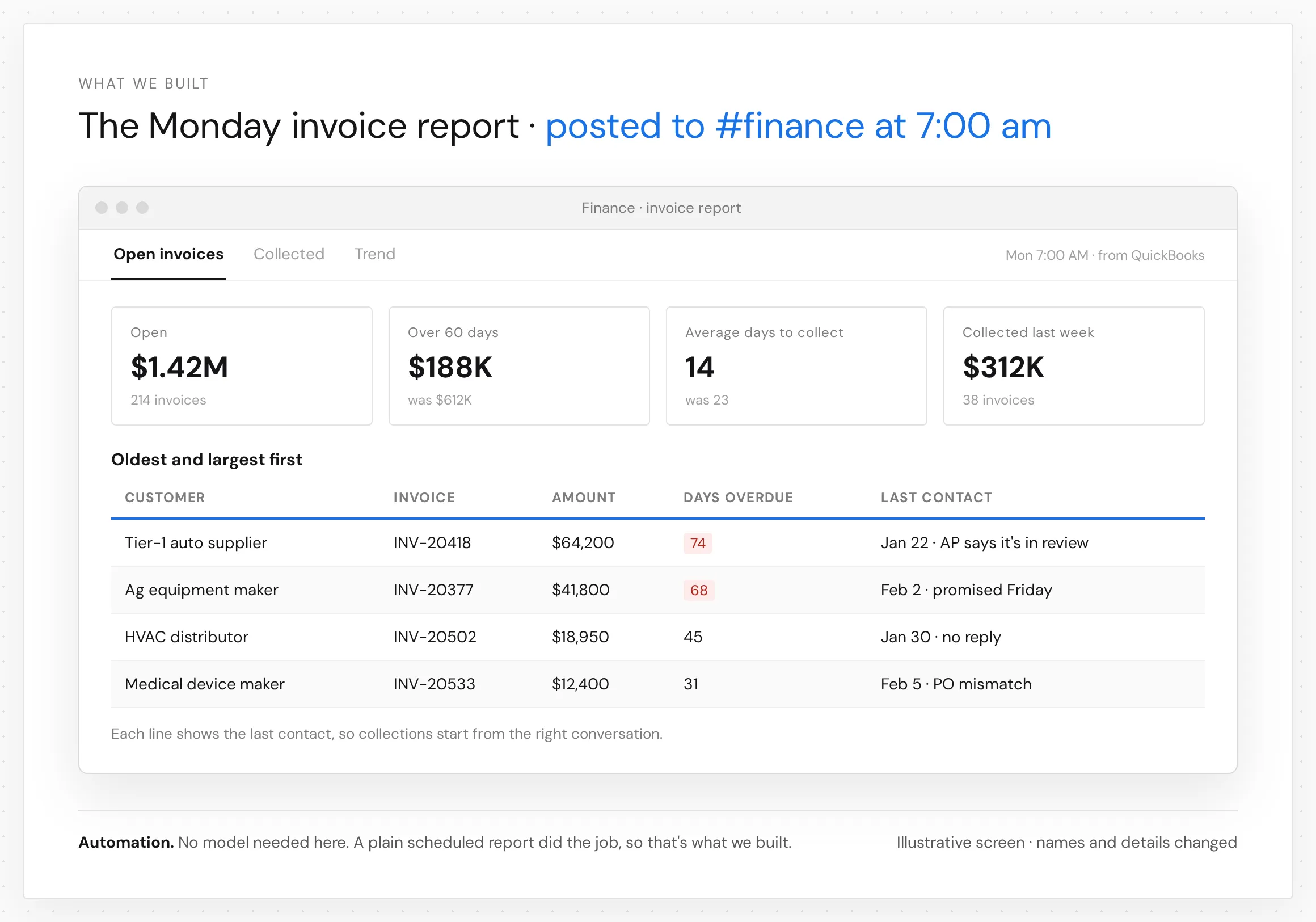
The invoice report came next. Every Monday at 7:00 am, an automation pulls open invoices from QuickBooks, sorts them by age and amount, and posts the list to the finance Slack channel. Each line shows the customer, the amount, days overdue, and the last contact.
The onboarding AI employee reads BambooHR every hour. When a new start date appears, it builds that hire’s schedule from the playbook, adjusted for shift, role, and plant.
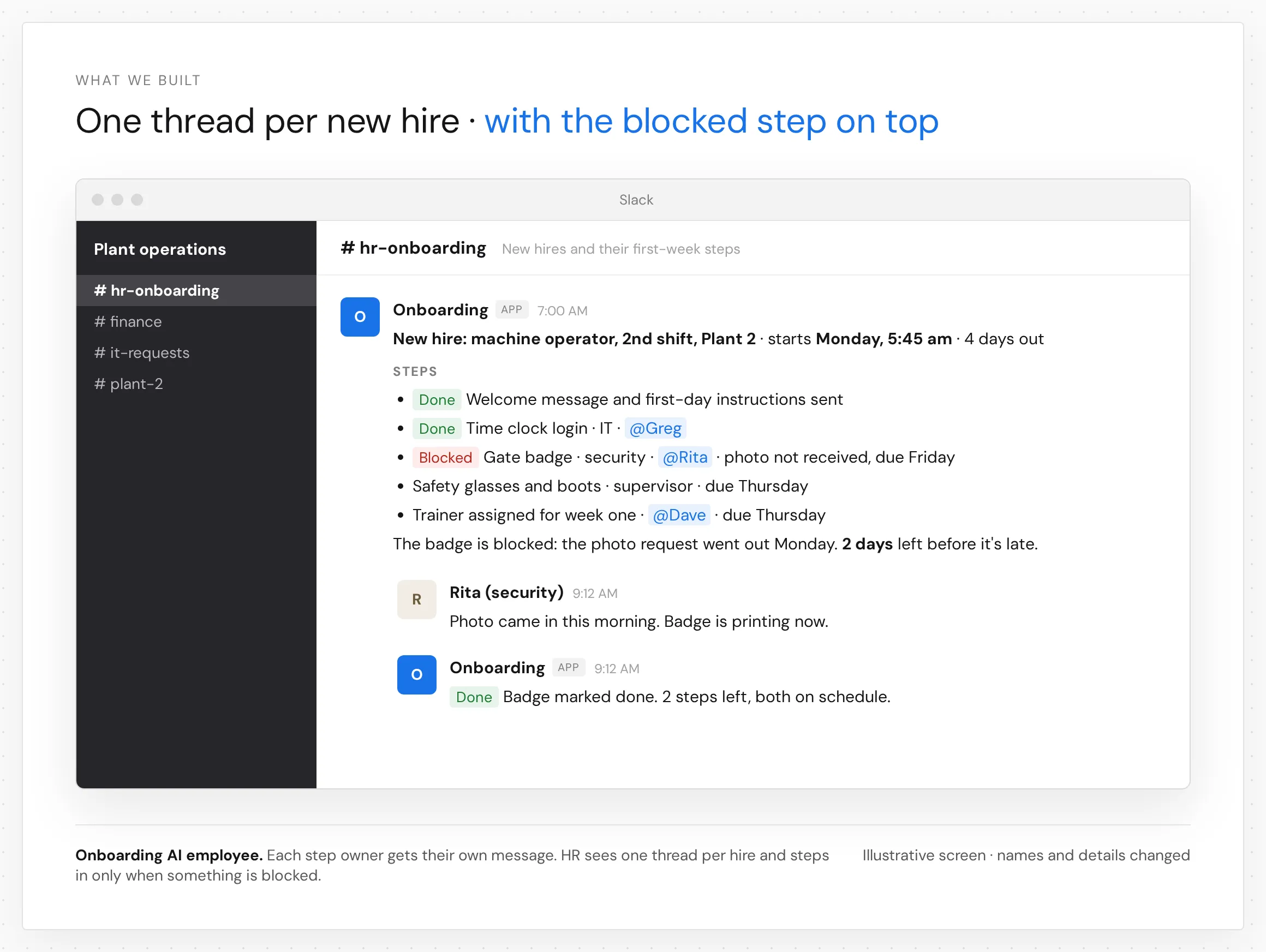
It sends the welcome message, the first-day instructions, and the week-one check-ins on that schedule. It also messages each step owner in Slack: IT for the login, security for the badge, the supervisor for the trainer.
When a step is late, the employee flags it as blocked. Blocked steps go to the HR manager in one Slack thread per hire, with who owns the step and how many days are left before the start date.
The access review runs on the first of each month. It compares the BambooHR roster with the user lists from Google Workspace and the 14 business tools. Any account without a matching active employee goes to the IT manager for approval to close.
The monthly audit agent reads every automation, every subscription, and every charge on the company cards. It reports what each one costs, who owns it, how often it ran, and whether anything changed since last month.
The cost dashboard rebuilds every night at 1:00 am. It tracks spend on every model call and every subscription, so a jump shows up on the controller’s screen the next morning.
The vendor-quote workflow watches a dedicated purchasing inbox. A small model sorts each reply as a quote, a question, or noise, then pulls out price, lead time, and terms into a shared sheet for the buyer.
No single model does everything. A small, fast model sorts vendor email and routes HR questions. A stronger reasoning model runs the monthly audit. A drafting model writes onboarding messages in the company’s voice, and a person approves anything that changes access or leaves the company.
Matching model to task kept running costs under $350 a month. It also means we can swap any single model when a better one ships, without rebuilding the rest.
Rollout and training
Day one was invisible to everyone outside the pilot. For the last two weeks of the build, the onboarding AI employee ran in shadow mode. It drafted schedules and messages for eight upcoming hires that no new hire saw.
The HR coordinators compared each draft against what they would have sent. They marked tone, wrong dates, and missing steps. The comparison was the first round of training.
Go-live started with first-shift hires at the main plant in week eight. Second and third shift joined in week ten, after a 90-minute session where both coordinators approved, edited, and paused real schedules.
Finance got a two-hour session on working the Monday invoice list. IT learned to read the access review and approve closures. The HR manager now owns the onboarding playbook, so changes no longer wait on Phos AI Labs.
Making it better
The early messages needed work. HR edited 44% of onboarding messages. Most fixes were about shift times, because second-shift hires were being told to arrive at 6:00 am.
We fixed it at the source. Each shift’s start time and gate went into the playbook, and the employee now reads the shift from BambooHR before writing anything.
The blocked-step flags had a different problem. IT often finished a login but forgot to tick the box, so the employee flagged steps that were already done. We connected it to Google Workspace, and it now checks whether the account exists before raising a flag.
In week five, the nightly cost dashboard showed model spend jump from about $11 a day to $140. We traced it to one setting: after a test, the vendor-quote workflow had been left on the reasoning model instead of the small one.
We switched it back the same morning. Then we added a line to the monthly audit agent: check every system’s model setting against its design, and flag any that changed. The spike is the reason the monthly audit exists in its current form.
In month three, a newer reasoning model came out. We ran it on the last three months of audit data before switching. It found every issue the old model had found plus two Make scenarios still running for a customer the company no longer served, so we swapped it in.
Every two weeks, HR, finance, IT, and Phos AI Labs meet for thirty minutes. We review edits, update the playbook, and pick what to tune next. By week twelve, the onboarding edit rate was down to 9%.
The outcome
In October, a maintenance technician was hired for second shift. On the Tuesday before his start, the onboarding AI employee flagged that the forklift certification class was full.
The HR manager moved him to Wednesday’s class with one reply. On Thursday, his badge was printed and his time clock login worked. On Monday at 2:45 pm, his supervisor met him at the right gate.
Starts like that are now normal. The controller opens Slack on Monday to a sorted list, and the IT manager closes accounts the day someone leaves.
| KPI | Baseline | After 90 days |
|---|---|---|
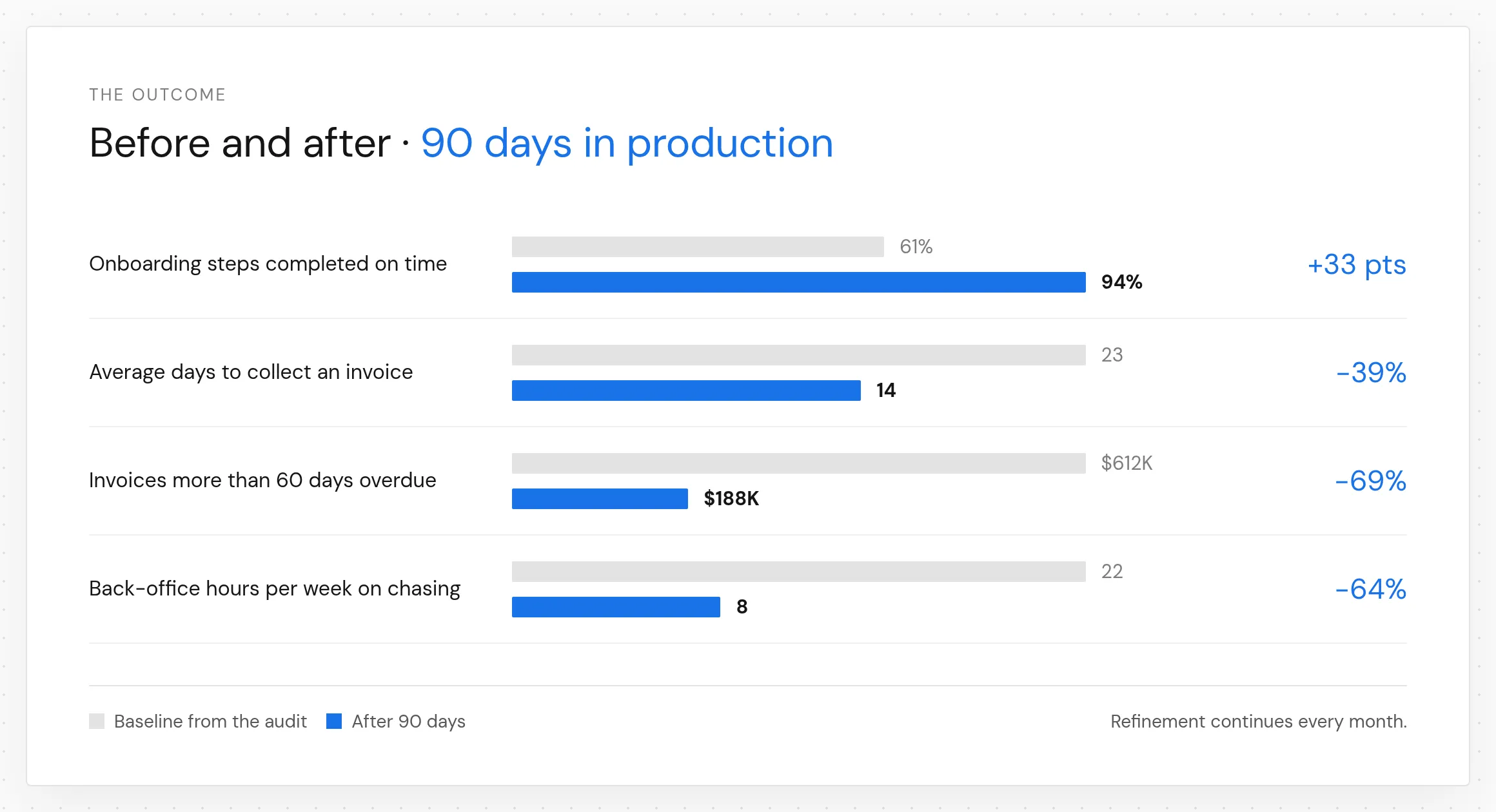
| Onboarding steps completed on time | 61% | 94% |
| New hires who left in the first 30 days | 6 of 40 | 1 of 22 |
| Average days to collect an invoice | 23 | 14 |
| Invoice dollars more than 60 days overdue | $612,000 | $188,000 |
| Software subscriptions without an owner | 17 | 0 |
| Active accounts belonging to people who had left | 23 | 0 |
| Monthly spend removed by first audit | n/a | $2,900 |
| Back-office hours per week on routine chasing | 22 | 8 |
The first monthly audit found 11 subscriptions nobody used, including two design tools that did the same job. Cancelling them saved $2,900 a month, which pays for the running costs eight times over.
The Monday report removed a job nobody wanted. The monthly audit found two things we would have missed.
What’s next
The project doesn’t have an end date. Each HR edit teaches the onboarding AI employee, and each new model generation makes the audit sharper. We retest every model release on past audit data before switching.
Next, we will connect the audit to purchasing, so unused subscriptions are flagged 30 days before they renew. The target is 10 days to collect and 98% of onboarding steps on time by the end of next quarter.
If your back office runs on someone remembering, Phos AI Labs can find the routines that are one busy week from breaking.
Client details changed under NDA.