The problem
On a Tuesday in February, the executive director spent the day at a state budget hearing in Springfield. She skipped the weekly development call on Zoom.
On that call, the development director mentioned that a family foundation needed a signed letter from her by Friday. The letter was the last piece of a $180,000 renewal for the youth mentoring program.
Nobody wrote it down as a task. On Thursday, the program officer sent a reminder. It landed under 41 newsletters, vendor pitches, and platform notices, and she found it the following Monday.
The foundation moved the renewal to its next cycle, nine months out. Everyone had done their job. The commitment just had nowhere to land.
Where Phos AI Labs came in
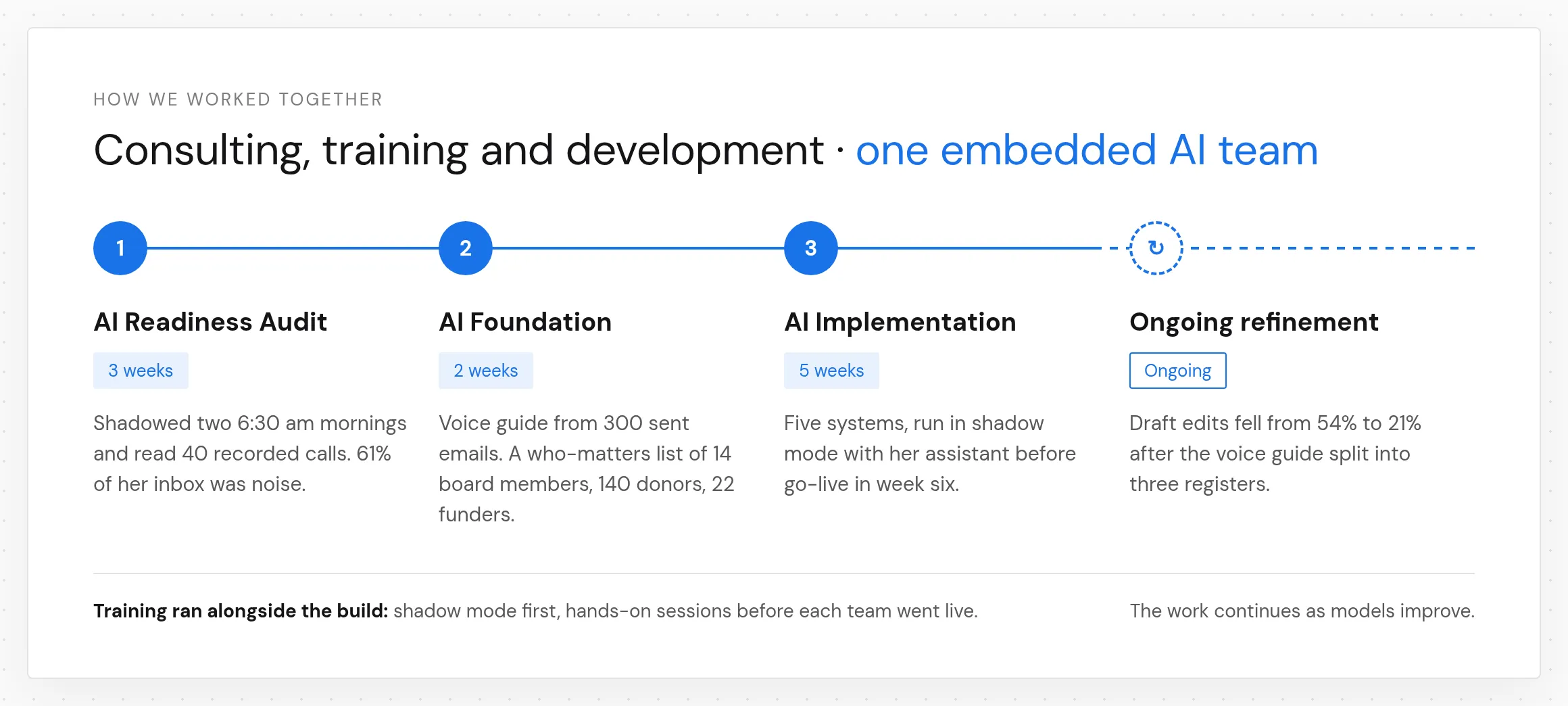
Phos AI Labs started with a three-week AI Readiness Audit. We interviewed the executive director, her executive assistant, the development director, the CFO, three program directors, and the board chair.
We shadowed two of her mornings from 6:30 am. She opened Gmail, then Google Calendar, then her Zoom recordings, and spent the first hour working out what had happened while she was elsewhere.
Then we read the data. We pulled 90 days of email metadata, six months of calendar history, 40 recorded Zoom calls, and the grants calendar the development team kept in Google Sheets.
Three findings shaped everything after. Her inbox was 61% noise. Commitments made on calls she missed rarely reached a task list. And she walked into most donor meetings having read nothing about the person across the table.
The baseline
Before we recommended a single tool, we put numbers on the problem. The numbers became the scoreboard for the whole engagement.
| KPI | Baseline |
|---|---|
| Morning orientation time | 62 min |
| Action items from skipped calls captured | 62% |
| Donor and board email response time | 7 hrs |
| Routine replies drafted before 7:00 am | 0% |
| Meetings with a written brief beforehand | 15% |
| Hours per week on meeting prep | 5 |
| Donor and grant deadlines missed per quarter | 3 |
| Major donor meetings per quarter | 22 |
The three missed deadlines stood out. Each one traced back to a call she had skipped or an email buried under mail nobody needed to read.
Setting the foundation
The AI Foundation phase took two weeks. We sat with the executive director and her assistant and wrote down how she works, because most of it lived in her head.
The voice guide came from 300 of her sent emails. It covers how she writes to board members, to long-time donors, to foundation program officers, and to her own staff, and the phrases she never uses.
We wrote a “who matters” list next: 14 board members, 140 major donors, 22 active funders, the leadership team, and three state legislators’ offices. Mail from anyone on the list jumps every queue.
The approval policy sits in the same document. No email leaves the organization unless a person presses send. Anything to a board member, a funder, a donor above $10,000, the press, or an elected official needs her approval personally.
We added one rule specific to a non-profit. The systems never read threads labeled for program participants, so case details about the families the organization serves stay out of every prompt.
Deciding what to build
With the baseline and the rules in hand, the Phos AI Labs engineering team joined the account. Their job was to decide what kind of system each problem needed, because each problem needed something different.
We looked at three common options first. A human chief of staff would cost about $140,000 a year and still spend mornings rebuilding context. An email assistant that sends on its own could reply to a major donor in the wrong tone.
A meeting note-taker was the third option. It would produce summaries of every call, and nobody would read them, because the summaries never turn into tasks with owners.
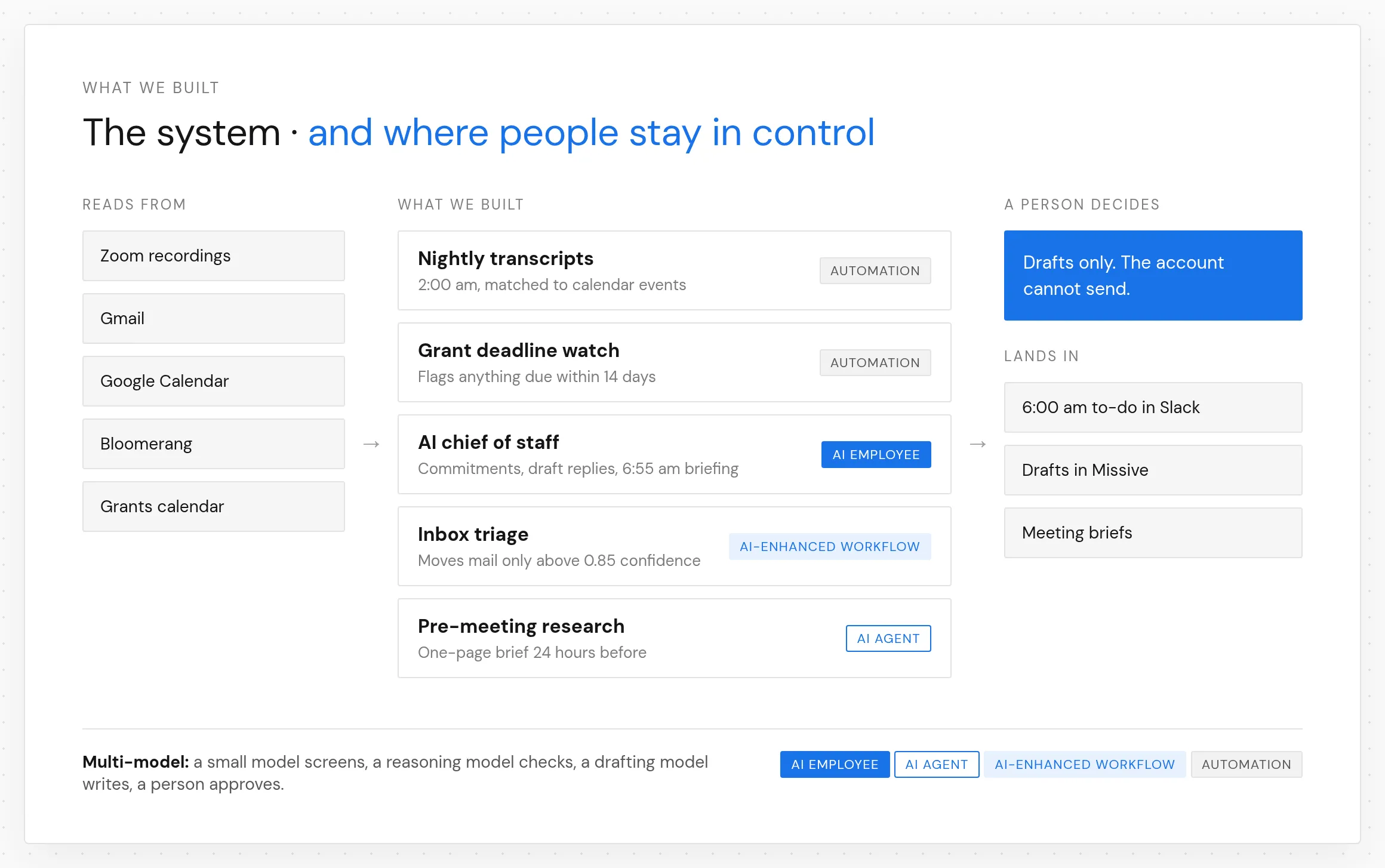
So we matched the tool to the job. Copying data on a schedule became two automations. Sorting the inbox, one decision inside a process she already had, became an AI-enhanced workflow. Researching people before a meeting became an AI agent.
Only one job needed an AI employee: owning her morning end to end. The job means reading yesterday’s calls, deciding what she needs to know, drafting her replies in her voice, and learning from every correction she makes.
The final design had five parts. An AI chief of staff, a pre-meeting research agent, an AI-enhanced inbox triage, a transcript sync automation, and a grant deadline automation.
The build
The build ran five weeks. The transcript automation came first, because everything else depended on it. Every night at 2:00 am, new Zoom recordings are transcribed and matched to the Google Calendar event they came from.
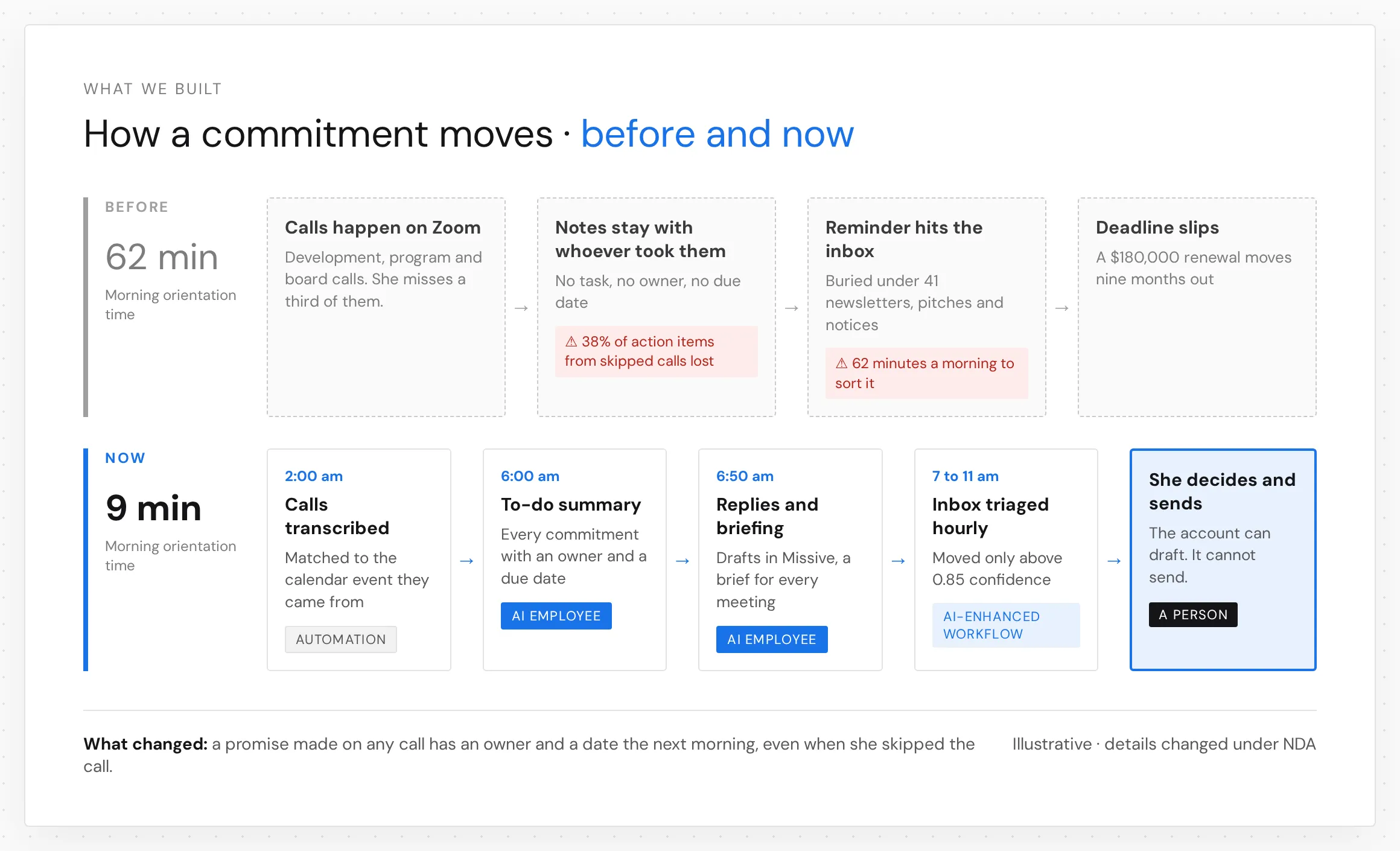
The grant deadline automation runs at 5:30 am. It reads the grants calendar in Google Sheets and open tasks in Bloomerang, the donor database, and flags anything due within 14 days.
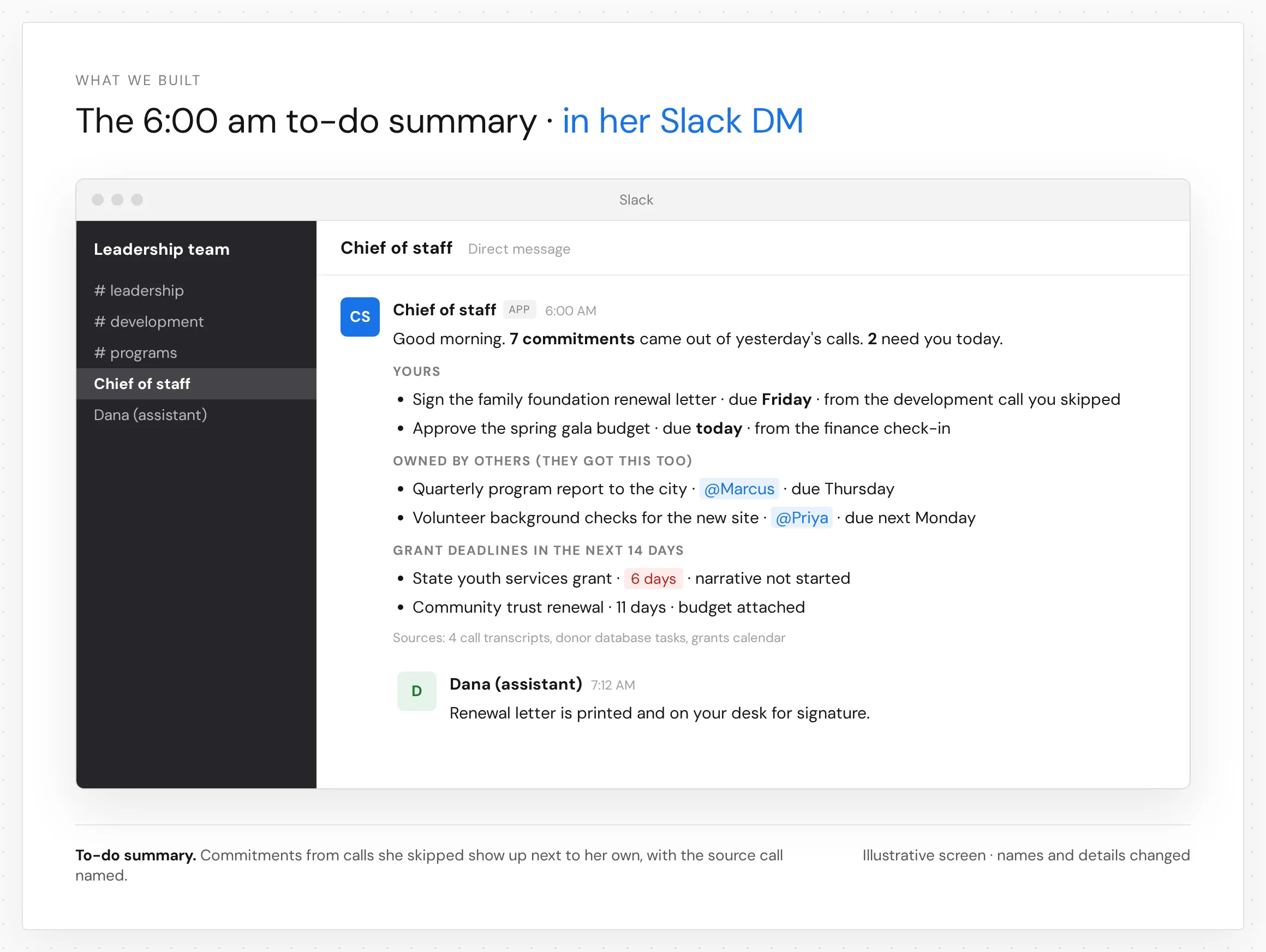
The AI chief of staff starts at 6:00 am. A reasoning model reads every transcript from the day before, including calls she skipped, and pulls out each commitment with an owner and a due date.
The to-do summary lands in her Slack DM at 6:00 am. Commitments that belong to someone else go to that person as well, so the development director sees the same Friday deadline she does.
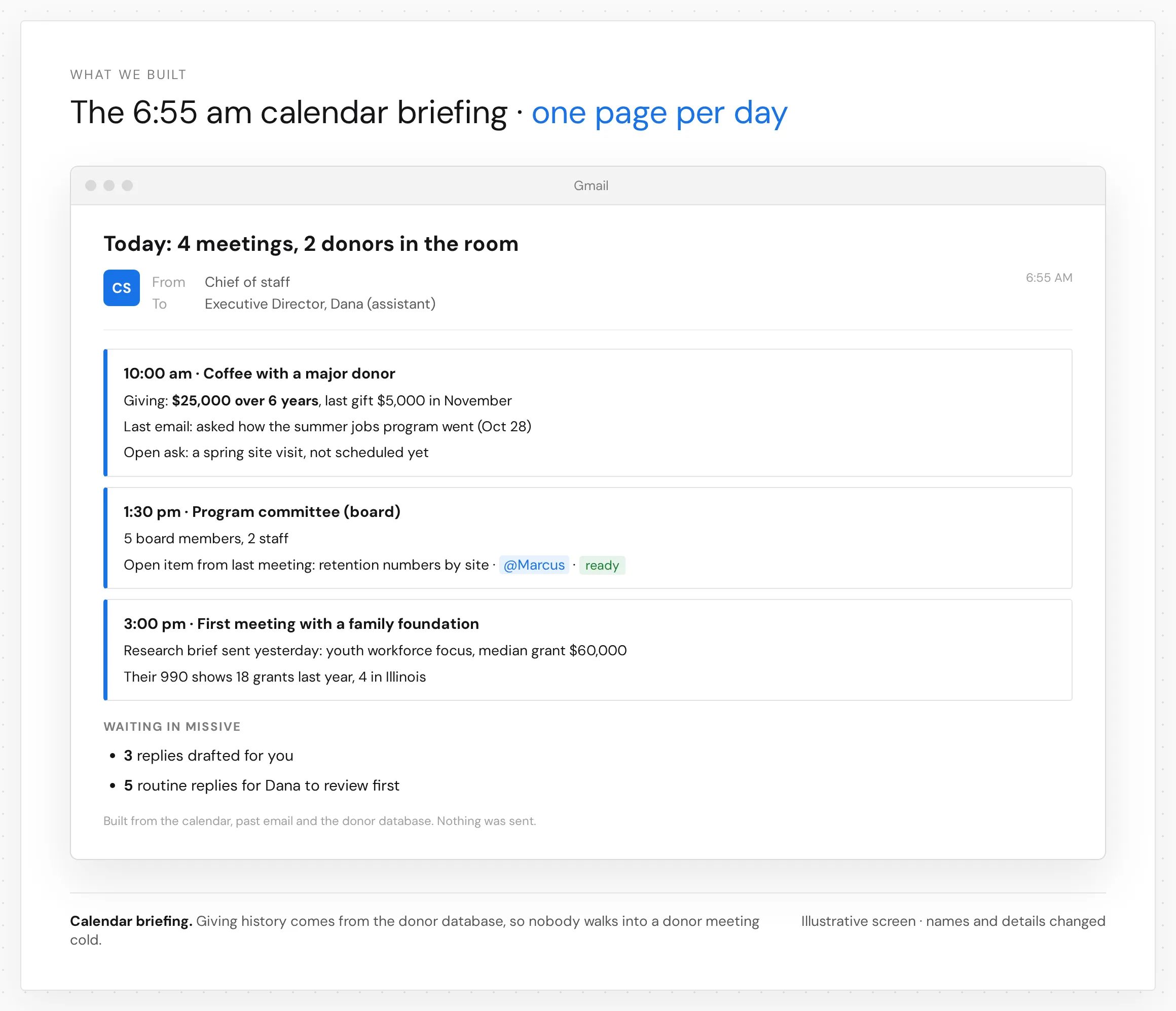
At 6:50 am, the AI chief of staff drafts replies to real human mail. Drafts go to the team inbox in Missive, never her personal Gmail, so her assistant can review the routine ones first.
At 6:55 am, it sends the calendar briefing. Every meeting shows attendees, the last email with each person, open asks, and giving history from Bloomerang for any donor in the room.
The inbox triage runs every hour from 7:00 to 11:00 am. A small, fast model classifies each new email as real mail, outreach, newsletter, or platform notice. Outreach gets routed, noise gets archived, and real mail goes to the draft queue.
The triage only moves an email when its confidence clears 0.85. Below that, the email stays in the inbox for a person to judge. A board member’s email filed as a newsletter costs more than a vendor pitch left in place.
The pre-meeting research agent runs 24 hours before any first meeting. It reads public bios, a foundation’s recent 990 filings and grant history, and any past email, then sends a one-page brief to her and her assistant.
The setup is multi-model by design. A small, fast model sorts mail at a fraction of a cent per email. A stronger reasoning model reads transcripts and researches. A drafting model writes in her voice. A person sends.
Matching model to task kept running costs under $400 a month. It also means we can swap any single model when a better one ships, without rebuilding the rest.
The last guardrail is the simplest. The email account the systems use can create drafts and cannot send. No prompt and no bug can change that, because the permission does not exist.
An optional phone agent handles logistics calls. It booked a table for 24 for the donor appreciation dinner and runs only when she turns it on.
Rollout and training
We didn’t flip a switch on day one. For the last two weeks of the build, the system ran in shadow mode. Every summary, briefing, and draft went only to the executive assistant.
She compared each one against what she would have prepared herself. The comparison was the first round of training, and it caught tone problems before the executive director saw a single draft.
Go-live started in week six with the executive director and her assistant. In week eight, the development director, the CFO, and three program directors joined, each with their own morning summary of commitments.
Everyone attended two 90-minute hands-on workshops. They read their own live summaries, corrected drafts on real threads, and learned to reply “wrong” to an action item so the AI chief of staff stops repeating it.
The executive assistant became the owner of the voice guide, the skip rules, and the “who matters” list. She updates all three herself, so changes no longer wait on Phos AI Labs.
Making it better
Tone took the longest to get right. In the first two weeks, the executive director edited 54% of drafts. Replies to long-time donors read too formal, and replies to foundation officers read too casual.
We fixed it at the source. We split the voice guide into three registers, one each for donors, funders, and staff. The drafting model now picks the register from the “who matters” list before it writes.
The to-do summary had a different problem. It pulled about 30 items a day, and most were small talk dressed up as tasks. We required a named owner and a date, which cut it to six to ten items a day that people acted on.
The triage misfiled two board emails in week three. Both came from personal Gmail addresses the list didn’t include. We added every board member’s personal address, and the triage has not misfiled a board email since.
In month three, a newer reasoning model came out. We tested it against 60 past meeting transcripts before switching. It caught 96% of commitments, up from 89%, so we swapped it in.
Every two weeks, the executive assistant and Phos AI Labs meet for thirty minutes. We review the edits, update the voice guide, and decide what to tune next. By week twelve, the edit rate was down to 21%.
The outcome
In September, the executive director spent a Tuesday on a site visit in Peoria. She missed a grants committee call where the team promised a community foundation a budget narrative by Thursday, for a $220,000 award.
At 6:00 am Wednesday, the commitment sat at the top of her summary with an owner and a date. At 6:50 am, a cover note was waiting in Missive. At 6:55 am, her briefing included a one-page brief on the program officer.
She edited two lines and sent it Wednesday morning, a day early. The foundation awarded the grant in October.
Mornings like that are now normal. She reads one summary over coffee, approves a short queue of drafts, and walks into donor meetings already briefed.
| KPI | Baseline | After 90 days |
|---|---|---|
| Morning orientation time | 62 min | 9 min |
| Action items from skipped calls captured | 62% | 97% |
| Donor and board email response time | 7 hrs | 1.5 hrs |
| Routine replies drafted before 7:00 am | 0% | 71% |
| Meetings with a written brief beforehand | 15% | 94% |
| Hours per week on meeting prep | 5 | 1.5 |
| Donor and grant deadlines missed per quarter | 3 | 0 |
| Major donor meetings per quarter | 22 | 36 |
| Outbound email approved by a person | n/a | 100% |
| Drafts sent without edits | n/a | 79% |
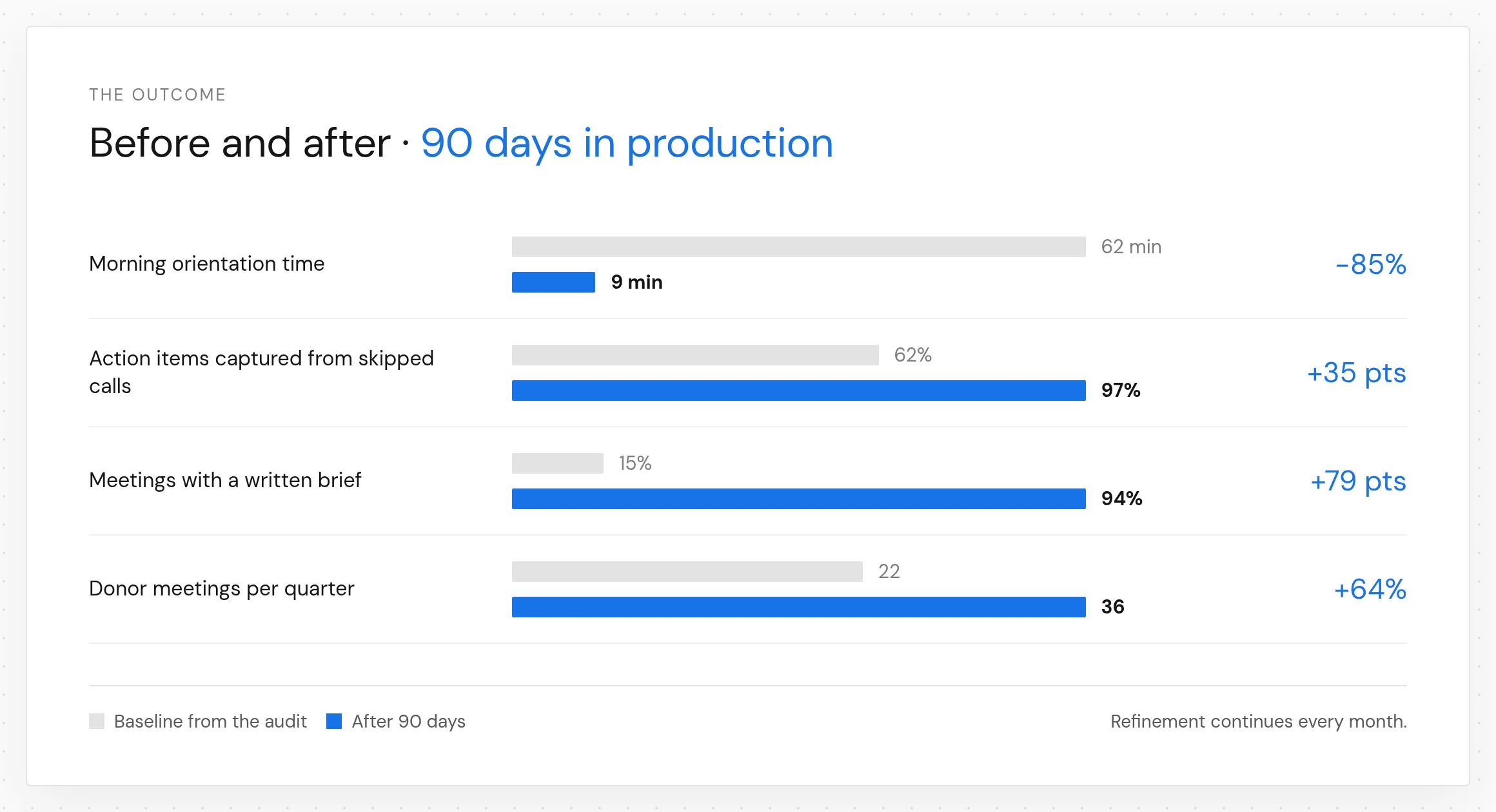
The executive director got back about eight hours a week. She spent most of them with donors, and the 14 extra major donor meetings in the quarter produced $310,000 in new pledges.
I used to spend my first hour figuring out what happened yesterday. Now I read it, change a few lines, and start on the decisions only I can make.
What’s next
The project has no end date. Each correction teaches the system, and each new model generation makes the summaries and drafts sharper. We retest every model release against the same 60 transcripts before switching.
Next, the AI chief of staff will assemble a first draft of the quarterly board packet from finance reports, program dashboards, and the quarter’s commitments. The target is cutting board packet prep from 12 hours to four.
If your executive director starts every day rebuilding yesterday, talk to Phos AI Labs. We’ll start by measuring what those mornings cost.
Client details changed under NDA.